

Call us toll free: (317)727-9173
Top notch Multipurpose WordPress Theme!

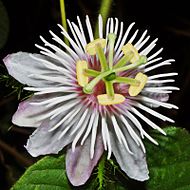
Herb Listing: Passiflora edulis (Passionflower) flower, seed or vine

by NaturPro in GHC Comments: 16


This is a listing page for Passionflower (Passiflora) products available directly from producers:

 

Location: Karnataka, India

Harvest Season: depends on plant part

Acres: 50

Certifications:
Good Agricultural Practices
Uses Organic Practices
Non-GMO

Farmer name: Sushil G.R.

Family Operated: Yes
Years in Operation at site: 50+

Asking price:

Flower: 300 INR/kg (shade-dried on-site)
Vine (stem): 65 INR/kg (cut and shade dried)
Seed: Inquire

Purchase Material: E-Commerce In Progress

Shipping: FOB Bangalore

Product Listing #: 389174


Passion Flower in Kerala, India:


Traditional use of Passionflower (Passiflora) (Wikipedia):

Passiflora, known also as the passion flowers or passion vines, is a genus of about 500 species of flowering plants, the type genus of the family Passifloraceae.

They are mostly vines, with some being shrubs, and a few species being herbaceous. For information about the fruit of the passiflora plant, see passionfruit. The monotypic genus Hollrungia seems to be inseparable from Passiflora, but further study is needed…..

P. incarnata (maypop) leaves and roots have a long history of use among Native Americans in North America and were adapted by the European colonists. The fresh or dried leaves of maypop are used to make a tea that is used for insomnia, hysteria, and epilepsy, and is also valued for its analgesic properties.[12][medical citation needed] P. edulis (passion fruit) and a few other species are used in Central and South America for similar purposes. Once dried, the leaves can also be smoked.

The medical utility of only a few species of Passiflora has been scientifically studied.[13] In initial study in 2001 for treatment of generalized anxiety disorder, maypop extract performed as well as oxazepam but with fewer short-term side effects.[14] It was recommended to follow up with long-term studies to confirm these results.

A study performed on mice demonstrated that Passiflora alata has a genotoxic effect on cells, and suggested further research was recommended before this one species is considered safe for human consumption.[15]

Passionflower herb (Passiflorae herba) from P. incarnata is listed in the European Pharmacopoeia. The herbal drug should contain not less than 1.5% total flavonoids expressed asvitexin.[citation needed]

Passionflower is reputed to have sedative effects and has been used in sedative products in Europe, but in 1978, the U.S. Food and Drug Administration prohibited its use in over-the-counter sedative preparations because it had not been proven safe and effective. In 2011, the University of Maryland Medical Center reported that passionflower “… can trigger side effects and can interact with other herbs, supplements, or medications. For these reasons, you should take herbs with care, under the supervision of a health care provider.”[16][17]

Passionflower is classified as generally recognized as safe (GRAS) for use in foods in the US,[18] and is “possibly safe when used orally and appropriately for short-term medicinal purposes,” “possibly unsafe when used in excessive amounts,” but unsafe when used orally during pregnancy since “…passionflower constituents show evidence of uterine stimulation.” The database suggests it is possibly effective for adjustment disorder with anxious mood, anxiety, and opiate withdrawal, but it “can cause dizziness, confusion, sedation, and ataxia” and there are some reports of more severe side effects including vasculitis and altered consciousness.

Article: Regulatory Compliance Systems for Supplements

by NaturPro in Quality Comments: 67

In the U.S., dietary supplements and their ingredients are subject to a patchwork of regulations, industry guidances, voluntary certifications, and audit programs.  With some exceptions, few of our standards have been developed with expert consensus and then broadly implemented by industry. FDA’s dietary supplement Good Manufacturing Practices (GMP) are part of the exception, and have made today’s supplement products generally a higher level of quality than at any time before.

Yet few industry standards are clearly understood, consistently applied, and sufficiently comprehensive to cover all the ground.  One primary example lies in the gap between compliance requirements for dietary ingredients (under food GMP) and dietary supplements, whose GMP framework is derived from that for pharmaceuticals. The underlying litmus test for the level of safety demanded for supplements and foods are different – that of ‘non-adulteration’ versus ‘safe for human consumption’.  Maybe due to the differences, supplement GMP audit programs often tend to overlook the food GMP that governs ingredients. So it is not uncommon for a manufacturer and a supplier to speak completely different quality languages. Audits for supplement GMP are frequently unable to determine to a reasonable degree of certainty whether a particular ingredient, based on its COA, should be expected to meet supplement requirements once it is placed inside a capsule or tablet.

As could be expected, an unintended consequence of this gap is the common practice of a raw material certificate of analysis being simply duplicated as the manufacturer’s raw material specification.  In this scenario, an ingredient specification has been developed according to food requirements, and often without any further analysis or verification, is assumed to meet the requirements of the finished supplement. The end result is a supplement that is essentially of no better quality than the “food-grade” ingredients put into it.

For botanicals and animal-derived raw materials, there is the added dimension of cultivation and processing before they are made into usable ingredients. This is a complicated problem, particularly for a global supply chain of agricultural materials that may or may not pick up contaminants during farming, harvesting, processing, storage or transportation to the ingredient processing facility. These contaminants may not be necessarily listed on the specification or controlled by the food GMP, yet can cause the supplements to which they are added to be adulterated.

Then there are the dozens of standards written for agricultural products, many of which don’t (or can’t) apply to the small family farmer that are a predominant source of botanical raw materials. In addition to recent FSMA requirements for fresh produce (which don’t really apply to dried agricultural materials), we also have USDA Good Agricultural Practices (which are intended for large farms and seldom fully practiced in the U.S.);  NOP Organic (which requires no testing for contaminants like pesticides that may cause a product to be adulterated); independent farm standards  like Global G.A.P. (also intended for large, modernized industrial farms); and dozens of Good Agricultural and Collection Practices (GACP) for medicinal plants that have been independently written by various nations and trade groups.

There are those who say that the mess of standards, the dynamics of industry, and the law of entropy do not support the possibility of a clear and unified regulatory structure.  Yet there are many others who recognize the limitations, yet remain busy sewing the patches together into a quilt that is greater than the sum of its parts.

Fortunately, a number of initiatives are in process or recently completed that contribute to the integrity of our industry quilt, and have provided a lot of free information.  Just in the past couple years:

  • The U.S. Pharmacopoeia and American Herbal Pharmacopoeia have developed a number of monographs and methods for testing dietary supplement ingredients.
  • USP has also developed a Food Fraud Mitigation Database that lists adulterants common for food ingredients
  • AOAC International has developed a number of analytical methods for dietary supplement ingredient potency and contaminants.
  • The NIH Office of Dietary Supplements website has become a valuable source of information and resources.
  • Trade groups like the American Herbal Products Association and American Botanical Council have made enormous efforts to educate and guide the industry on issues around botanical dietary ingredients and adulteration, including a recently updated draft GACP from AHPA, and the ABC-AHP-NCNPR Botanical Adulterants Program.
  • The Supplement Online Wellness Library (or OWL) was established by the Council for Responsible Nutrition, to allow labels for supplement products on the U.S. market to be put into in one place.
  • The Supplement Safety and Compliance Initiative (SSCI) was formed as a broad industry initiative, with wide support from the trade associations, to address some of the gaps for supplements that aren’t sufficiently covered under other standards.  SSCI is led by a number of experienced players in retail, manufacturing and supply, and includes a focus on identity, risk assessment and quality for raw materials.
  • In response to consumer demand, a number of leading retailers, manufacturers and ingredient suppliers have invested significant resources into traceability and quality, and are now able to make meaningful claims to these effects that are not only important to consumers, but also serve as a reliable way to differentiate from the competition.

Today’s movement towards a greater level of education and transparency includes a firming of the gaps, especially where raw material traceability and quality are concerned. Successful companies across the entire supply chain are actively improving and adopting new standards as they come along, building a level of quality and integrity that provides lasting value to their business.  Those who are upping their game are piecing together a quilt of their own, leveraging their quality advantages into claims that deliver marketing value. On the other side, those who continue to rely on ignorance or a lack of regulatory clarity as reason to take no action are increasingly left behind.

In an industry where faceless online product marketers are more common than they should be, and where a list of the tens of thousands of products on the market is just getting kicked off, efforts to fill in the gaps of our patchwork are probably a good thing for everyone.

First published in Natural Products Insider