

32 Years After DSHEA, FDA Debates Meaning of “Dietary Substance”
What the heck is a dietary supplement, under the U.S. law known as DSHEA?
A core part of the debate is whether ‘dietary substance’ was intended as the same meaning as ‘present in the food supply’.
Some fringe thinkers want to paint them as the same, and rewrite their own take into law to only include stuff people eat as part of food. But DSHEA was clearly not written or intended that way.
At the March 27, 2026 FDA meeting to examine these questions, attorney Ivan Wasserman brought maybe the clearest interpretation I’ve heard yet.
He mixed in common sense with historical application on DSHEA with Supreme Court precedent, offering an illustration that went beyond — on the meaning of words and why we should heed warning on revisionist thinking.
—-
DSHEA listed several types of substances that are allowed in supplements.
Many herbs, individual amino acids, and metabolites of vitamins are examples of dietary supplement ingredients not necessarily found in the food supply, but which are fully allowed in supplements, by the word of the law.
If an ingredient isn’t in the food supply, the law allows alternative scientific review pathways to determine their safety and legality: Old Dietary Ingredient (ODI) and New Dietary Ingredient (NDI), along with Generally Recognize as Safe (GRAS) are those pathways.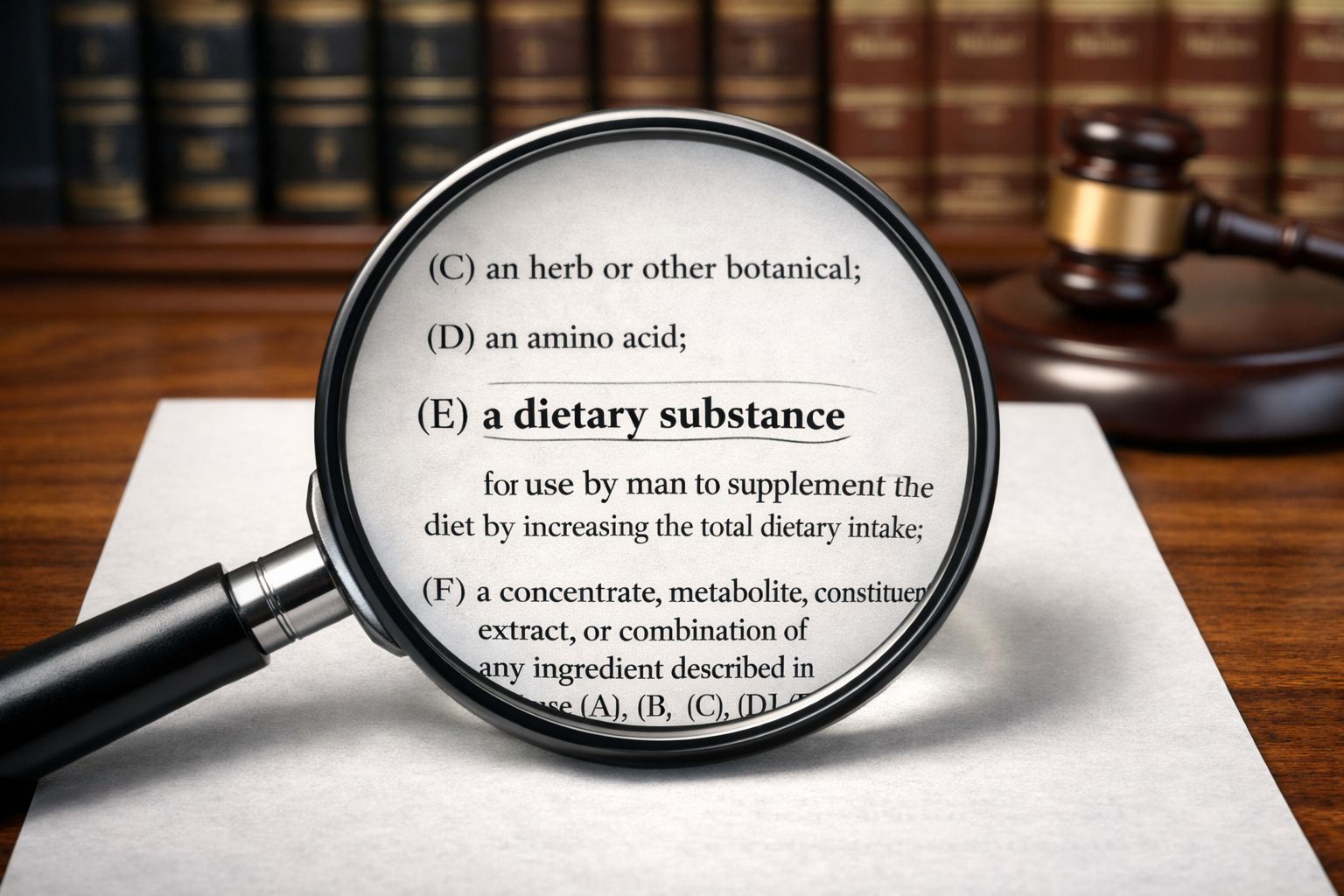
Mr. Wasserman quoted the 1995 case Gustavson vs Alloyd, where Justice Anthony Kennedy wrote, “Under the canon of consistent usage and meaningful variation, a court must presume that a word or phrase bears the same meaning throughout the statute, and conversely that a material variation in terms suggests a variation in meaning.”
Wasserman continued, “We know that the drafters knew the phrase ‘present in the food supply’ and used it in Section 413, but chose not to use it in Section 201 — and instead chose to use the phrase ‘dietary substance.’
“Following Justice Kennedy’s guidance, reading ‘dietary substance’ to have the same meaning as ‘present in the food supply’ is against the canon of statutory interpretation that ‘a material variation in terms suggests a variation in meaning’. It has to have a different meaning.”
—–
Words matter. The intent and the wording of laws matter. And how the law has been practiced for 32 years with a $60 billion industry with an excellent record of safety also matters.
Congress did not invent new terms for dietary substances and dietary ingredients — along with a new process for reviewing their safety in 1994 — for armchair regulators to come along in 2026 and claim they are the same thing as food or drugs.
A clear, new definition of dietary supplement was established by Congress in 1994 — along with the sensible path for how they are to be regulated.
This point, strengthened by Supreme Court precedent that yes, different words have different meanings, may not have been obvious to those in the room falsely claiming to use science to protect public interest.
But it was obvious to the rest of us.
——–
What were my top takeaways from the March 27, 2026 FDA meeting exploring the scope of dietary ingredients, specifically Section 201(ff)(1)(E) of the Federal Food, Drug, and Cosmetic Act: “a dietary substance for use by man to supplement the diet by increasing the total dietary intake”?
1. Supplements continue to be the safest things people can ingest which are regulated by FDA.
If Congress intended for supplements to be food or drugs, they wouldn’t have created and signed DSHEA in 1994. They would have made supplements a food or a drug instead.
DSHEA clearly works as a regulatory framework, even if sufficient budget to enforce it have never been provided.
—-
2. If Congress intended for supplements to be foods, they would not have called the ingredients “dietary substances’ in DSHEA. We wouldn’t be calling them dietary ingredients today. They would have used the other terms already used in 1994 for food ingredients.
If Congress intended for supplement ingredients to be GRASed like food ingredients, DSHEA would not have led to a new classification and safety review process, called New Dietary Ingredient (NDI).
Industry has been waiting on the promised final guidance on NDI notifications for many years. It is not industry’s fault that some firms elect the more strict GRAS path versus NDI. That is also part of the current law since 1958.
—-
3. There’s no evidence the self-affirmed GRAS pathway, called ‘secret GRAS’ by one group, has led to any safety concerns for supplements.
No ingredient is a secret to FDA. They see self-GRAS ingredients at least 2-3 times — at the port, in manufacturing facilities, and on product labels.
If the ‘secret-GRAS’ folks had any evidence of safety concerns of self-affirmed GRAS, surely that would not be kept a secret.
—–
4. It seems to me that the commonsense middle path is right in front of us under DSHEA: FDA can clear the path for NDI by addressing the questions posed by new ingredient technology and answered by the ample science on them.
FDA can also continue to review and request documentation for all self-GRAS ingredients they see at the port, in the facilities and on the label.
Together, this fixes the self-GRAS issue, if there’s one at all.
—–
5. A lack of sufficient Congressional appropriations and funding for dietary supplements at FDA has not been helpful to the process, and along with constantly changing Presidents and their political appointees, has created the current situation of manufactured confusion.
Other developed countries have developed working systems where supplements are regulated somewhere between food and drugs — similar to how Congress intended in 1994.

Sorry, the comment form is closed at this time.