
August 29, 2026:
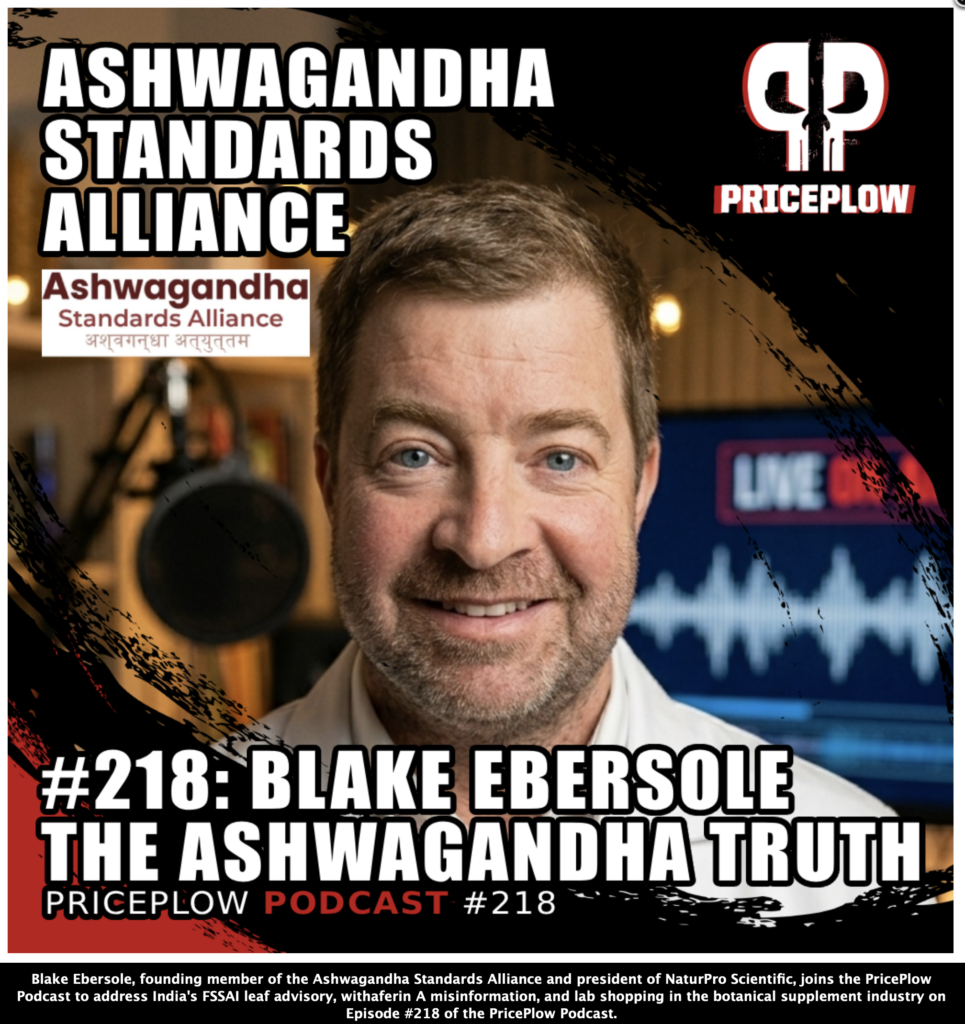
On Logan Talks Health, Blake Ebersole, co-founding member of the Ashwagandha Standards Alliance, discusses ashwagandha quality, plant-part controversies, testing methods, analytical transparency and why a percentage such as “5% total withanolides” may not tell consumers what they think it does.
An edited transcript of this interview is found below:
Logan:
Why don’t we start with a bit about yourself and how you became so interested in botanical quality?
Blake:
I’ve always been interested in natural medicines. My dad’s side of the family is Pennsylvania Dutch Mennonite, and they always used home remedies. You’d smell apple cider vinegar every time you walked into my grandparents’ house, along with Epsom salts.
I was first exposed to supplements when I was in seventh grade. I was walking to wrestling practice, saw a GNC, and they promised I’d get ripped. I thought, “Yeah, I probably need that.” So I bought Ripped Fuel from Twinlab, which at the time contained a lot of ephedrine.
That was my first experience with supplements on my own, other than Flintstones vitamins. I remember thinking, “Holy shit, supplements can really knock you off your feet.”
Later, I worked in food and was always interested in food and nutrition, so supplements became a natural fit.
I started in the industry on the supply-chain side, learning how ingredients are made, how plants are grown and sourced, and how extraction works. I was responsible for quality, so I saw what was actually being produced and sold into the market.
For roughly the past 10 years, I’ve worked with brands and manufacturers to make sure they’re buying the right ingredients at the right level of quality, while also helping with product development, formulation and related work.
It’s a somewhat hidden part of the industry. Most people don’t know where saffron is grown, how it’s extracted, where it’s processed, or how somebody determines whether a product is actually 100% saffron.
Adulteration has existed for as long as humans have traded valuable goods. The spice trade has always had dilution—adding a little less of the expensive material or mixing something in to increase margins because you think nobody will notice.
That culture can exist because policing is expensive and time-consuming. Regulators have limited resources for testing, so to a significant extent the industry operates in a self-regulatory environment. People in quality, laboratories, suppliers and brands all have to help establish expectations for appropriate testing and transparency.
That’s why things like sharing certificates of analysis and explaining testing methods matter. We now have better opportunities for transparency and communication than we had before.
Logan:
Ashwagandha appears to be facing possible restrictions or bans in some European countries. What do you think about that? Do you think it’s safe?
Blake:
I’ve been following this for some time. I’ve worked with ashwagandha for almost 20 years.
Whenever something becomes popular and develops into a very large market—and ashwagandha is estimated to be roughly a $1.5 billion market—you start seeing the problems associated with rapid growth.
You get opportunists coming in. Some diluted materials. Others use analytical methods that can make their product appear more potent or stronger than competing products. You see many of the same games that occur with other expensive or high-value botanicals.
A group of us who have worked on the ashwagandha production side for many years started discussing these issues a couple of years ago. That became the Ashwagandha Standards Alliance. More recently, we’ve been working with scientists reviewing the larger body of evidence.
When you look at approximately 130 clinical studies and more than 30 safety and toxicology studies involving different forms of ashwagandha root and leaf, the overall evidence supports safety.
When something is consumed at the scale of billions of doses, some people are inevitably going to become sick or seek medical care while also taking that product.
A multivitamin provides a useful analogy. There are many adverse-event reports involving multivitamins in the United States, but that doesn’t necessarily mean the multivitamin caused the event. Multivitamins are simply consumed by a very large number of people.
That’s an important perspective when looking at adverse-event reports for ashwagandha as well.
It’s good that systems exist to collect these reports, but they need to be interpreted in the context of the overall evidence, including the safety and toxicology studies conducted on different forms of root and leaf.
When I look at the science overall, I don’t see evidence of a general safety problem.
There has also been a major controversy around plant part, particularly claims that ashwagandha leaf is inherently toxic. I don’t see a safety signal supporting that conclusion either.
What gets obscured by that debate is the underlying quality problem: opportunists entering a growing market, manipulating testing methods, misrepresenting products, diluting materials or failing to disclose what they’re actually selling.
Sometimes products don’t identify plant part at all. The label simply says “ashwagandha extract.” If the plant part isn’t disclosed, the consumer is none the wiser.
It’s a fascinating example of how a complex botanical ingredient can be simplified and gamed for short-term commercial advantage.
Logan:
I’ve seen this whole root-versus-leaf debate, and it sometimes looks like a marketing differentiation: “The leaf is bad. We’re pure root. You don’t want the leaf.”
What is that based on? Is there evidence that leaf is worse or dangerous?
Blake:
That’s what makes the situation interesting.
Companies developing products legitimately often spend years developing the ingredient, putting it through clinical studies and conducting safety studies.
Some of the established root-and-leaf products have more research behind them than many other botanical ingredients we routinely discuss. They’ve also been marketed globally for 10 years or more, giving us substantial commercial experience.
Looking at those data and that experience, I don’t see a reason to conclude that leaf itself presents a general safety problem.
Another issue is how ashwagandha is classified.
Traditionally, it isn’t simply consumed as an unrestricted conventional food in every population. Most modern clinical and safety studies are geared toward the way a supplement would be consumed.
If you try to treat something as a conventional food, you may need to consider unrestricted consumption by children, pregnant women, nursing women and other populations.
Keeping it in a supplement framework allows appropriate directions, warnings and restrictions to be used on the label.
There are also competitive issues underneath these regulatory debates. Companies can have commercial reasons for positioning another type of product as unsafe while portraying their own as preferable.
That’s why the discussion has to come back to evidence.
Logan:
Another way to get the system right is testing. For people listening, where does the United States Pharmacopeia fit into this?
Blake:
Testing across the supplement industry is often a black box, and that creates opportunities for gaming.
One example is “lab shopping.” A company can send the same material to several laboratories and then gravitate toward the laboratory or method that gives the result it wants.
USP has methods for ashwagandha potency and identity. Ideally, having a common method gives everybody an apples-to-apples reference.
Companies can also use proprietary methods. There’s nothing inherently wrong with that. But the method needs to be appropriately validated, disclosed where necessary, and reproducible. Another qualified laboratory should be able to perform the method and obtain comparable results.
If somebody says, “You can’t have our method and nobody else can replicate our result,” that becomes a serious quality and GMP concern.
This matters when a company claims a certain percentage of withanolides. If the analytical method is being used to inflate the apparent strength of the product, but nobody can see or reproduce the method, the number becomes almost meaningless.
You can end up with a competition where everybody wants to claim 5% withanolides.
But then you look at the economics and chemistry and ask: Does the mass balance make sense? If producing a genuine material at that concentration should cost substantially more than the selling price, you have to ask questions.
Regulators may not prioritize that situation if they don’t consider it an immediate safety issue. That means the industry, laboratories, brands and buyers have to scrutinize it.
Logan:
It’s essentially a company saying, “We’re going to mark our own homework. Nobody else can mark it, and we’re not going to tell you how we marked it because the method is secret.”
Blake:
Exactly.
If you’re putting a compositional number on the label, it needs to be something that can be verified.
A lot of finished-product companies are simply putting a number on the label because the ingredient supplier told them that number. They may not be independently verifying it.
Laboratories also play a role because some of this testing is effectively a black box.
Sometimes reports don’t show the chromatographic peaks or identify exactly which withanolides are being quantified. Then you compare that result with a USP-based analysis and the reported withanolide content can be dramatically different.
Logan:
That’s what I’ve seen. Some laboratory reports don’t quantify which withanolides are being tested. Put them alongside a United States Pharmacopeia test and the results can look completely different.
Blake:
Right.
It’s important to understand that two analytical methods can measure a group of compounds differently. It’s common in botanical raw-material specifications to see potency reported using two or even three methods, with different expected results.
The USP method measures a defined group of compounds. Other researchers and suppliers have used techniques such as NMR and broader chromatographic characterization to look at a larger fingerprint.
Companies may spend significant amounts of money developing those methods and generating the evidence needed to support them.
Reference standards are another bottleneck. If you’re trying to quantify a particular compound, you ideally need an appropriate chemical reference standard. If that reference isn’t available, is prohibitively expensive, or can’t be obtained in sufficient purity, it becomes much harder for independent laboratories to reproduce the method.
That’s part of the role of pharmacopeial methods: to establish methods that are practical and broadly usable.
Ashwagandha contains a large number of withanolides and withanosides. We’re still trying to understand those compounds and how different extracts reflect the underlying root or plant material.
Then you get into fingerprinting.
If the botanical starting material shows a fingerprint containing many peaks, but an extract shows only two or three dominant peaks, what happened during processing?
Now you need to look at the fingerprint and ask: Is this root? Is it leaf? What is the potency? What was concentrated or removed?
It becomes a puzzle.
Logan:
The pharmacopeial method obviously doesn’t capture every withanolide.
But if you’re a supplier developing an ashwagandha ingredient with a different profile, surely you would want to share enough about your testing method to demonstrate that you’re actually meeting your label claim.
Blake:
You would.
But there can be a commercial problem.
Suppose you’ve historically labeled your ingredient using one number, and then improved testing shows that the old number isn’t directly comparable to the new one. How do you change the number while simultaneously claiming that the ingredient has remained the same all along?
That becomes especially important when clinical research is involved.
You need to connect the commercial material being sold today with the material that was actually used in the clinical studies.
If you materially change the manufacturing process, you have to ask whether those clinical studies still apply to the product in the same way.
Logan:
So companies can change the process used for the commercial material compared with what was used in the studies?
Blake:
It can happen. Processes are modified for efficiency, cost reduction or other reasons.
Maybe you remove a manufacturing step and save money.
But one of the original purposes of standardized botanical extracts was to help protect against exactly this kind of variability—to establish that a product maintains particular characteristics rather than simply being whatever came out of an extraction process.
There are also ways to dilute botanical extracts without adding an obvious foreign adulterant.
For example, you can take exhausted botanical material left over after extraction, grind it and blend it back into the extract. Think of grinding up spent coffee grounds and putting them back into a coffee extract.
The material technically originated from the same plant, but you’ve diluted the extract with material from which many of the soluble constituents have already been removed.
Then people wonder why that ingredient is so inexpensive.
This isn’t unique to ashwagandha. Similar practices can occur with many botanical extracts.
A lot of this is hidden, even though people working in botanical supply, production and quality know these practices exist.
Logan:
I love the fingerprint idea.
If we’re conducting research on an ashwagandha extract, ideally the study would publish its fingerprint or withanolide profile.
Then you could say: This specific ashwagandha preparation was studied for stress or anxiety and produced these results.
In theory, a consumer could look for a product with a similar profile and have more confidence that it resembles the studied ingredient. You might also discover that different withanolide profiles produce different effects.
Blake:
Exactly.
If a clinical study isn’t linked to the actual composition of the material, your ability to determine whether another product reproduces that material is limited.
Of course, suppliers don’t necessarily want to publish every detail of their manufacturing process or fingerprint because they don’t want competitors copying them. That’s understandable.
Natural products can be difficult to protect through patents. If a company invests substantially in developing an ingredient, it doesn’t want somebody else simply knocking it off.
But if you withhold too much compositional information from a clinical publication, you create another problem: nobody can determine what was actually studied.
There can also be a legitimate evolution in testing. Maybe the manufacturing process hasn’t changed, but the analytical method improves and now measures more withanolides.
That brings us directly to the phrase “total withanolides.”
When someone says “total withanolides,” the first question should be: Which withanolides?
What are the individual compounds being included in that total?
If one company’s “total withanolides” consists of seven compounds and another company’s consists of 20, those numbers aren’t necessarily apples-to-apples.
Logan:
And they could potentially have different biological effects.
Blake:
Potentially.
You also have to ask whether an extract is representative of the botanical material it supposedly came from.
If a root has a complex fingerprint containing 20 or 30 relevant peaks and an extract has only two or three, what does “full spectrum” mean in that context?
Is two or three peaks “full spectrum”? Or should a full-spectrum product more closely reflect the broader fingerprint of the starting material?
Those are legitimate questions.
The problem is that companies often don’t publish their chromatograms or analytical methods. Occasionally you can find them in studies, but often you can’t.
Ideally, we would have official monographs and agreed reference methods. Then everybody could point to the same benchmark.
When those connections aren’t being made, it can start to feel like the Wild West.
Logan:
It’s almost as though companies are trying to create intellectual property out of the chemistry. They don’t want to reveal enough information for the product to be recreated.
Blake:
That’s part of it, and it isn’t entirely their fault.
Natural products are difficult to patent. If you’re a company investing heavily in developing an ingredient, you don’t want another company copying it immediately.
The problem comes when somebody competes by creating something different but uses analytical claims that make it appear equivalent or superior.
Then you’re trying to compete against somebody whose numbers may not be comparable to yours.
Logan:
Your website says the Ashwagandha Standards Alliance wants to see analytical harmonization. What do you mean by that?
Blake:
Analytical harmonization can mean several things.
To me, one practical starting point is for everybody to use at least one common reference method.
For example, your specification could include the USP method as one line item. Then, on another line, you could include your own proprietary method.
Now we at least have one apples-to-apples reference point, even if companies also use additional methods.
Maybe the USP method gets updated in the future to include more compounds. But using multiple potency methods isn’t unusual in botanical products. We’ve seen similar approaches with other herbs such as ginkgo.
The concept isn’t new.
Logan:
But those additional methods still need to be transparent enough that we can understand what they’re measuring and which peaks they include.
Blake:
Correct.
Even USP is limited in which compounds it currently measures, so there’s room to go deeper.
Then you get into another question: Are the marker compounds we happen to measure actually the biologically important compounds?
Just because a compound is predominant, easy to measure, or has interesting activity in an in-vitro experiment doesn’t necessarily mean it alone determines the clinical effect.
If you concentrate particular withanolides while excluding other constituents, does the resulting extract behave differently?
That’s an entirely different scientific discussion.
When you look across roughly 130 clinical studies involving a wide range of preparations—root, root-and-leaf, water extracts and other extraction systems—you see positive results across many preparations.
That tells us there is clearly something meaningful happening with the botanical.
The safety evidence is also there. So when evaluating the plant overall, you have to consider the complete body of work.
Logan:
And ashwagandha is consumed by millions of people. If it were causing a very large safety problem, you would expect to see a signal.
Blake:
Exactly. We’re talking about enormous numbers of doses consumed globally.
Logan:
What regulatory changes would you like to see for ashwagandha?
Blake:
I don’t necessarily think major new regulations are what’s needed.
Ashwagandha is already legally marketed under different regulatory frameworks in countries including Canada, South Korea, Italy and many others.
The bigger issue is enforcement.
If regulators don’t have the resources to aggressively police misleading labels or unfair competition, then industry stakeholders have to take more responsibility for addressing those issues.
I think we need to resolve the misinformation around plant part and get back to the fundamentals:
What compounds are being measured?
What process was used?
What is the composition of the extract?
What safety evidence and clinical evidence are actually tied to that particular extract?
It is certainly possible for an unscrupulous supplier to use inappropriate processes, concentrate certain constituents from leaf and then misrepresent the resulting material as root.
Standards should address that.
But don’t describe a quality and authenticity problem as though it is inherently a plant-part problem.
Logan:
You could have products that are all called ashwagandha but, in theory, have very different chemical compositions.
Blake:
Absolutely.
Historically, a common specification for ashwagandha root extract was around 1.5% withanolides by HPLC.
But those older specifications weren’t necessarily tied to USP or another harmonized method.
Different root extracts, root-and-leaf extracts and solvent systems could all be sold under what appeared to be the same 1.5% specification.
That was 20 years ago.
Now you see 2.5%, 5% and other variations.
There can be many different things going on behind those numbers even though the products look similar on the front of the label.
Logan:
So, in some cases, people are essentially manipulating the chemistry to reach the number they want to put on the label.
Blake:
That’s the incentive.
To a consumer, 5 looks stronger than 2.5, and 2.5 looks stronger than 1.5.
That higher number becomes a marketing tool.
But the ingredient supplier and the finished-product brand have different responsibilities.
Ultimately, the brand owner is responsible for what goes on the finished-product label.
If the supplier is located halfway around the world, recovering losses or pursuing litigation after something goes wrong can also be extremely difficult.
Logan:
I’m seeing some brands remove 5% claims from their labels.
Blake:
Yes.
If you look historically at labels, you can find brands that appear to have removed those claims. One possible reason is that they weren’t able to reproduce the claimed result under the testing they were using.
Other brands may continue with the claim.
This issue is familiar to a lot of people who have worked behind the scenes in ashwagandha quality assurance and manufacturing.
They’ve faced the dilemma: “The specification says 5%, but our laboratory isn’t getting 5%.”
You can call it a deviation for a while, but eventually you have to address the discrepancy.
Either the claim changes, the testing issue gets resolved, or somebody decides to ignore the discrepancy.
Logan:
And carries on as normal.
Blake:
Right.
These are also growing pains of a rapidly expanding category. We’ve seen similar issues with green tea extract, turmeric extract and other popular botanicals.
The positive thing is that the quality problems we’re discussing haven’t translated into the level of serious adverse-event reporting you might expect if ashwagandha itself presented a major safety problem.
But consumers can still be cheated.
If a label says you’re getting a particular amount of withanolides and the product doesn’t actually contain that amount under a defensible method, then the consumer isn’t getting what the label suggests.
Logan:
Do you think the enormous demand required to support a $1.5 billion market contributes to the problem?
Companies suddenly need huge quantities of ashwagandha. Maybe that creates pressure to change growing practices or manufacturing simply to produce enough material.
Blake:
Definitely.
The market has grown extremely quickly over the past decade.
Small farmers have entered the market. Small processors, medium-sized processors and large processors have all entered. Almost everybody in India involved in botanical extracts seems to offer some type of ashwagandha.
Leaves are somewhat richer in some withanolides and are generally less expensive than root.
That creates an economic incentive to use more of the plant.
In India, the term panchang can refer to use of the whole plant. From a traditional processing or agricultural perspective, people may reasonably ask why stems and leaves should simply be discarded.
Historically, extracts have been made in different ways.
As botanical identity testing improved, laboratories became better able to distinguish plant parts. Larger and more sophisticated suppliers generally adapted to those expectations.
Smaller suppliers may not always conduct the same level of laboratory testing.
If an identity test costs a few hundred dollars per sample, a small supplier may decide not to perform it and instead rely on whoever supplied the raw material.
That’s why the problem has so many layers.
You peel back one layer and find another.
Logan:
At every level of the supply chain, there’s another opportunity for something to go wrong.
Blake:
Exactly.
The companies involved in the Ashwagandha Standards Alliance include organizations that have processed and sold ashwagandha globally for 20 years or more.
They’ve seen these problems firsthand.
They also see opportunistic products entering the marketplace, competing unfairly and potentially damaging the reputation of the entire ashwagandha category.
There are also consequences to simplistic regulatory actions.
If, for example, leaf is broadly prohibited, that can affect farmer income and remove value from a plant part that is already used in established commercial products.
Then you put more pressure on the remaining supply, potentially creating additional incentives for shortcuts.
Logan:
So a restriction could actually increase supply pressure and potentially incentivize more trickery.
Blake:
Exactly.
And established brand names aren’t automatically immune from quality problems either.
The goal of the Alliance is to establish better standards, correct misinformation and make sure the public discussion is scientifically sound.
We don’t want companies unfairly competing by misleading consumers.
And we don’t want quality problems to become a scandal that damages the entire botanical.
Consumers aren’t necessarily going to remember which plant part, supplier or extract was implicated. They may simply conclude, “Ashwagandha isn’t worth the risk.”
That would conflict with the broader scientific record showing that ashwagandha is a generally well-established and well-studied botanical.
Logan:
My last question: How can consumers spot a good ashwagandha product?
Blake:
I wish I had a short answer.
That’s part of the problem we’re trying to solve.
In my head, I have a list of red flags and green flags that buyers can look for, and I think turning that into consumer guidance would be useful.
There are established branded ingredients whose specifications and testing I’ve personally reviewed and where I have confidence in the documentation. That doesn’t mean a product needs to use a branded ingredient to be good. There are excellent non-branded suppliers as well.
In general, though, I tend to look for suppliers and brands with a long track record and substantial experience.
If somebody is claiming 5% total withanolides, I would ask more questions.
I would want to see the certificate of analysis and understand the methodology used to reach that 5%, because it’s a relatively high specification and can be difficult to reproduce depending on the method.
Five percent is definitely a claim where I want to know more.
Logan:
And even if you have a COA saying 5%, it can’t simply show unquantified peaks. You need to know what was measured and how the laboratory reached that number.
Blake:
Exactly.
This should ordinarily be handled during supplier qualification, but even a sophisticated consumer or buyer could ask for the HPLC chromatogram showing the peaks.
A supplier making that kind of claim should know exactly what you’re asking for and should be able to provide appropriate analytical documentation.
In a truly transparent industry, representative chromatograms generated using standardized methods would be readily available.
But that’s often where the sausage gets made, so companies can be reluctant to disclose it.
Still, there are suppliers that have completed the validation work and are willing to say, “Here are our results. Send the material to another qualified laboratory using the same method, and you should get comparable results.”
We need more of that.
Logan:
We need more companies like that on planet Earth.
Blake:
We’re working toward it.
The industry is moving in that direction. More companies are sharing test results and quality documentation.
In the United States, for example, cannabis companies in some states have been required to make certificates of analysis available.
The supplement industry could learn something from that model.
Imagine if companies made a third-party COA available for every finished-product batch. Consumers and customers could look at the testing and see what was actually measured.
That would improve transparency significantly.
Logan:
I think that should be the law: a third-party COA for every batch, available to consumers, showing the dosage and the quantified compounds.
Blake:
That’s close to my ideal world, and I think we’re moving in that direction.
Testing itself doesn’t have to be mysterious.
You send the material to a qualified laboratory and obtain the report.
If you built quality into the product in the first place—selected appropriate ingredients, qualified the supplier and understood your specifications—the laboratory result shouldn’t come back as a surprise.
For companies that know what they’re doing, testing is verification.
Problems arise when quality wasn’t built into the product at the beginning and people start trying to figure out how to make the test result work after the fact.
Logan:
At that point, they can be in a difficult position. They’ve sent the product to a laboratory and effectively demonstrated that an expensive batch may be mislabeled.
Blake:
Exactly.
And it happens more often than people realize because testing can come relatively late in the process.
Then somebody says, “We can’t just throw this batch away. What do we do?”
Sometimes the temptation is simply to sell it anyway.
As a quality professional, I’ve advised against that many times. I didn’t always get my way.
Logan:
Blake, this has been a fascinating conversation and extremely helpful. I think people are going to find your experience really interesting.
Thank you very much for your time.
Blake:
Absolutely, Logan. It was great being with you. These were excellent questions, and it’s refreshing to have a conversation with somebody who understands the issues we’re talking about.
Thanks for having me.
Editor’s note: This interview has been lightly edited for length and clarity. Verbal fillers, repetitions and false starts have been removed, and obvious transcription errors have been corrected. The speakers’ substantive comments and intended meaning have been preserved.
←ASA Expands Global Membership Initiative as Kerry Group Joins Coalition
Comments
Leave a Reply
Logged in as ashwagandhastandards. Edit your profile. Log out? Required fields are marked *
Comment *
Notify me of follow-up comments by email.
Notify me of new posts by email.
More posts
- ASA Member Explains Testing Methods, Quality and the Problem With “Total Withanolides”
- ASA Expands Global Membership Initiative as Kerry Group Joins Coalition
- ASA Supports Safeguard Ashwagandha at EU Parliament Meeting
- Ashwagandha Standards Alliance Responds to India’s Ministry of AYUSH, Launches With Global Membership Initiative
Ashwagandha Standards Alliance advances science-based education, safety, quality, and standards for ashwagandha ingredients in supplements and foods.
Welcome to Airo for WordPress
Sign in with your GoDaddy account to start building your site with AI.Sign in with GoDaddy