
Call us toll free: (317)727-9173
Top notch Multipurpose WordPress Theme!

Ashwagandha TRUTH: Blake Ebersole on Labeling & India’s Leaf Ban | PricePlow Episode 218

by NaturPro in Uncategorized Comments: 0

Posted on PricePlow on May 21, 2026 — The supplement industry is pushing back. In May 2026, a group of long-tenured ashwagandha producers and regulatory experts launched the Ashwagandha Standards Alliance (ASA), a new coalition dedicated to countering misinformation about ashwagandha leaf safety, defending GMP standards, and responding to what many in the industry see as scientifically unsupported regulatory actions: India’s April 2026 FSSAI/AYUSH leaf advisory and Denmark’s earlier ban.

(Read the article at PricePlow Blog here.)

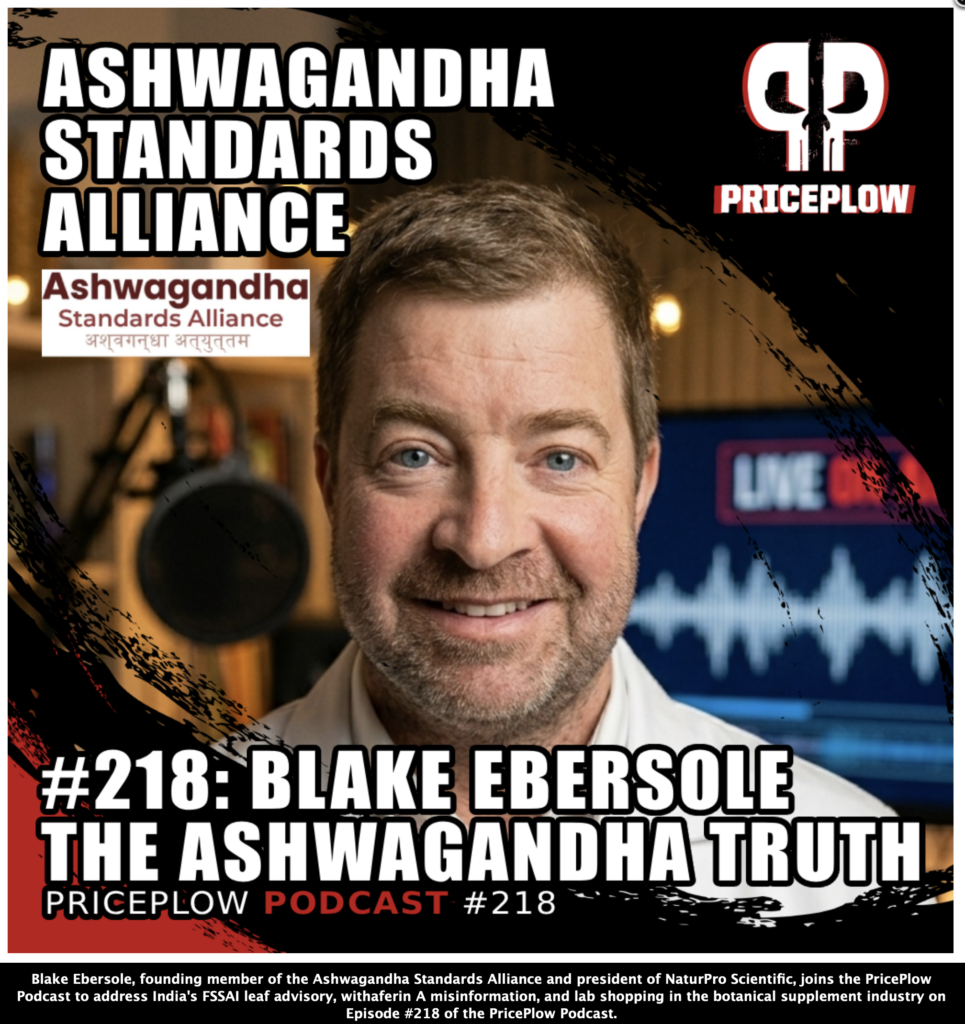
In Episode #218 of the PricePlow Podcast, Mike and Ben sit down with Blake Ebersole, founding member of the ASA and president of NaturPro Scientific, a B2B quality and regulatory consulting firm. Blake unpacks and rejects the “root good, leaf bad” narrative, explains why in vitrocancer cell studies are being misused to target ashwagandha leaf, and details how lab shopping and supply chain fragmentation quietly erode quality across the botanical category.

View video on YouTube here: Ashwagandha TRUTH: Blake Ebersole on Labeling & India’s Leaf Ban | Episode 218

This episode pairs directly with our companion article on India’s ashwagandha leaf advisory. Together they cover both the regulatory deep-dive and the industry coalition response.

Blake Ebersole, founding member of the Ashwagandha Standards Alliance (ASA) and president of NaturPro Scientific, joins Mike and Ben to address the growing controversy around ashwagandha leaf safety: debating the “root good, leaf bad” narrative, India’s 2026 FSSAI/AYUSH advisory, Denmark’s hazard-based ban, and the withaferin A in vitro science being misused across the industry. The conversation goes far beyond regulatory news. The guys dig into:

  • Lab shopping and the broken incentive structure in supplement testing
  • Supply chain fragmentation in India and how it creates quality failures at scale
  • Label disclosure: plant part, withanolide content, and maltodextrin dilution
  • The difference between hazard-based and risk-based regulatory frameworks
  • The ASA’s three founding executive members: Sabinsa, Cepham, and Arjuna Natural
  • Formula ideas for the next wave of ashwagandha products (sleep, specific populations, acute stress)
  • Anhedonia, cortisol, and what the science actually says about ashwagandha’s mood effects

Sign up for ashwagandha news alerts on PricePlow: https://www.priceplow.com/ashwagandha Follow Blake Ebersole on LinkedIn:   / blakeebersole  

Ashwagandha Standards Alliance: https://ashwagandhastandards.org
TIMESTAMPS: 0:00 – Introductions 2:45 – What Is the Ashwagandha Standards Alliance? 4:30 – How ASA Fits Alongside AHPA and Trade Organizations 6:15 – Educational, Policy, and Standards Goals 8:00 – Adverse Events at Scale and Ashwagandha’s Safety Record 11:15 – Denmark’s Ban and the Hazard-Based Regulatory Model 15:15 – Withaferin A and the In Vitro Extrapolation Problem 18:30 – How Competitive Interests Drove the Market Off Track 21:00 – Label Disclosure, Dilution, and Maltodextrin 25:00 – The Billion-Dollar Market and Supply Chain Fragmentation 30:00 – India’s Regulatory Framework: Food, Drug, and No Middle Ground 32:15 – Farmers, Brokers, and Unintended Consequences 38:00 – Research Gaps and the Clinical Literature 41:00 – Extraction Methods: Milk, Solvents, and Withanolide Chemistry 44:30 – Consumer Education and the Demand for Transparency 46:30 – Lab Shopping and the Broken Incentive Structure 52:45 – Branded Ingredients and GMP Supplier Qualification 55:15 – ASA Founding Members: Sabinsa, Cepham, and Arjuna Natural 58:00 – Formula Ideas: Sleep, Lifestyle, and Beyond the Basics 1:00:45 – Anhedonia, Cortisol, and What the Science Says

Key articles and resources:

Thanks to Perfect Shaker for sponsoring the podcast: https://www.priceplow.com/perfect-shaker
Why Fearless Naturals USA is Different

by NaturPro in Uncategorized Comments: 0

Does your ingredient intel know how your ingredients are made?

Because a lot of platforms can tell you what’s available and trending. They can give you a possible match, what the studies say and what competitors are doing.

But we’re still left hanging with the biggest question:

Do you know enough about the ingredient, the supplier, and the documentation to trust what you’re buying?

Fearless Naturals direct ingredient sourcing and trust marketplace supplier

That’s where Fearless Naturals USA is different.

——

Some platforms make ingredients easier to find and buy.

Others generate more options.

Some platforms help people move faster through ingredient selection, while others help to focus on market, trends, and white space.

Those are all forms of intelligence, but Fearless is built around a different problem.

Trust.

——

Trust isn’t gained from “here’s an ingredient listing and a few nice claims”, “here’s is a giant catalog, good luck,” or “AI says this ingredient looks promising.”

Real trust comes from being more deliberate and selective.

Real trust is only gained based on structure, experience and evidence.

That is why Fearless isn’t really a marketplace — but more of an exclusive sourcing club.

——

We’re building the first controlled-access environment for serious buyers and trusted suppliers.

Not every supplier gets in, and not every buyer gets full visibility on day one.

That’s not a weakness — that’s the intended model.

Because premium ingredient sourcing doesn’t work like a flea market.

The best suppliers aren’t throwing their name into an open directory.

And discerning buyers don’t want to waste more of their time.

So Fearless isn’t the biggest list of whoever wants to register.

(And AI ain’t picking our ingredients, ever.)

We’re a place where serious buyers can evaluate serious suppliers with better evidence, better gating, and better judgment.

—-

The ingredient world doesn’t suffer from a lack of mediocre information.

We suffer from a lack of trust on ingredient quality and integrity.

We’re not here to show everyone everything that a computer can generate. Quite the opposite.

We’re here to show the right people — the Fearless Power Buyers — the best ingredients from the best suppliers.

That makes Fearless Naturals USA the first real trust marketplace for natural ingredients.

——

Launch is just weeks away. Subscribe for early updates here: https://lnkd.in/ePtPu99q

FDA Infant Formula Testing: Radical Transparency?

by NaturPro in Uncategorized Comments: 0

May 3, 2026 — Did FDA fulfill its promise on radical transparency on infant formula in the widely promoted Operation Stork Speed?

FDA’s recent infant formula testing results are reassuring. But in my opinion, they’re incomplete.

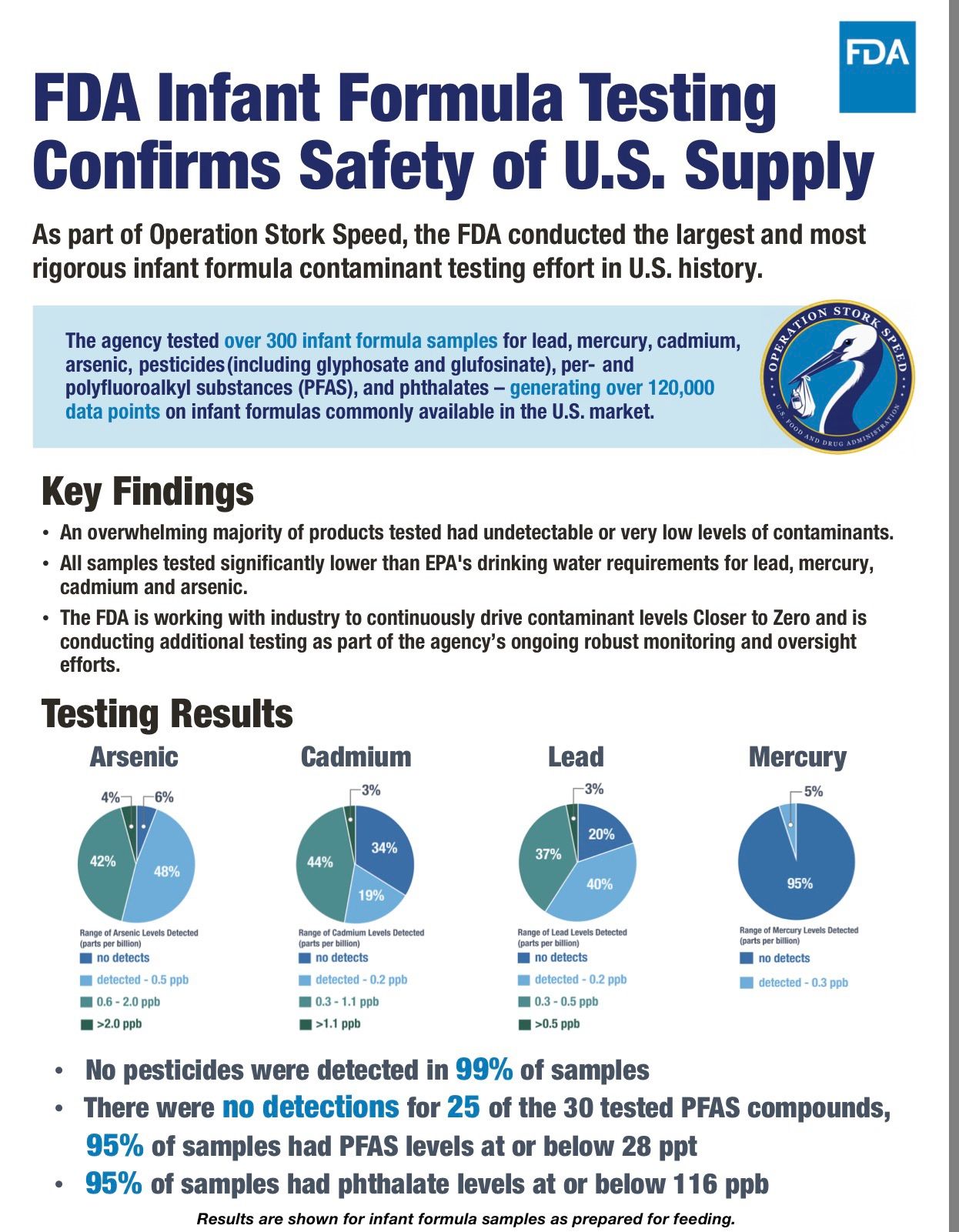
The agency reports that it tested more than 300 infant formula samples and generated more than 120,000 data points across lead, mercury, cadmium, arsenic, pesticides, glyphosate, glufosinate, PFAS, and phthalates.

Lab testing for infant formula foods for heavy metals, glyphosate and other contaminants

FDA says the overwhelming majority of products had undetectable or very low contaminant levels.

And no glyphosate, surely to the Secretary’s surprise.

That’s great, and kind of what I expected to see.

I don’t understand the rationale behind the study design, however.

Why were 318 pesticides tested, when formula ingredients aren’t considered sources of them?

Was BPA part of the pthalates tested? Did any testing include plastic baby bottle leaching data?

We don’t know.

We do know that infant formula containing cows milk ingredients can contain traces of veterinary antibiotics. Cleaning agents used in processing can contribute perchlorate. Acrylamide was part of prior discussions on infant formula. And does anyone remember melamine and its related nitrogen doping sources?

None of these appear to be included in the testing.

We know that infant formula can be a source of pathogens like Cronobacter and Salmonella — what caused the recent product recalls and shortages.

Why didn’t the study include common pathogens?

We don’t know.

——

Outside of study design, FDA’s communication still falls short of “radical transparency.”

No full report or raw data was provided.

A full report would include methods, detection limits, product and lab identifiers, quality-control data, and statistical treatment. Other than by reference to existing guidances, none of these were provided.

Without details, it’s hard to say that the public can independently evaluate the agency’s conclusions.

That does not mean FDA’s conclusions are wrong. It just means they are not fully verifiable based on what has been released so far.

——

FDA deserves credit for the testing and publishing the broad findings as a summary and fact sheet.

But if the promise was radical transparency, the next step is obvious: publish the full data package, and explain why key contaminants were omitted from the study.

Based on FDA’s summary, there does not appear to have been a broad contaminant crisis in U.S. infant formula, as previously stated by the guy running for President at the time.

There was a need for monitoring and better sharing of data.

But there may also have been a great deal of unnecessary fear.

We don’t know.

When the study design makes sense to food quality folks, and the results are provided as a complete package — maybe we can make a better conclusion then.

FDA Infant Formula Testing Results: https://www.fda.gov/food/infant-formula-homepage/fdas-infant-formula-product-testing-results

Home » Archives for May 2026

The Ashwagandha-AYUSH Truth Will Set Us Free

by NaturPro in Uncategorized Comments: 0

The truth will set us free.

Many are interpreting the AYUSH/FSSAI action differently than it actually is.

The Ashwagandha Standards Alliance, a robust, growing group of responsible firms, is addressing these and other related issues one by one.

Undeclared aerial-part substitution should be taken seriously. Yet ashwagandha ingredients from reputable suppliers already properly label plant part as part of GMP — so this looks like a bit of a red herring for other issues.

The action is also being interpreted as a regulatory restriction applying to countries outside India, when it is only a continuation of a misguided 2021 advisory and 2024 scientific reviews.

Ashwagandha Standards, Not Slogans

As a regulatory decision within India’s own traditional medicine and food framework, the ruling should not be misread anywhere else as a global scientific verdict that ashwagandha leaf is unsafe.

Overall, the action is misguided in a few ways.

First, the action conflates legitimate use of root and leaf with adulteration. “Adulteration” is a legal and regulatory definition and should not be thrown around casually.

The truth is, more than 30 clinical and safety trials have been conducted on properly labeled root+leaf products, showing an excellent record of safety and efficacy.

Second, the action neglects the body of evidence, recently compiled and published in Phytotherapy Research by Thomas Brendler and others, which shows an excellent record of safety for both root and leaf ashwagandha products.

Third, the action is based on a foundation of flawed, incomplete AYUSH-generated reports which omit a large amount of verified evidence, including the incorrect attribution of root-and-leaf evidence as root-only.

Fourth, the common argument that leaf was not used traditionally is incorrect. Tallon, Koturbash, and Blum’s 2025 systematic review in Phytotherapy Research catalogued leaf and aerial-part use across multiple traditional systems, including uses for fever, inflammation, wound poultices, and febrifuge applications in regional materia medica across India, Yemen, Ethiopia, Sudan, Jordan, the Sahel, South Asia, and other areas.

That does not mean all traditional leaf use automatically supports modern dietary supplement use — but that’s what we have scientific support for.

(When we have the science, how much of a difference does an already-incomplete historical record make?) Yet we are aware that any “no historical precedent” claim for leaf is incorrect and misguided.

The Ashwagandha Plot Bubbles and Thickens

by NaturPro in Uncategorized Comments: 0

The ashwagandha plot bubbles and thickens, and the crucible now precipitates visible impurity.

The Ashwagandha Standards Alliance applauds NutraIngredients for yesterday’s article by Asia Sherman, which illustrates all together the stark contrast between one popular narrative and the science.

The narrative says that root is authentic, that leaf is suspect, and that the Ministry of Ayush ban is a necessary correction.

But the science says something much different.

And to me, the real issue here is distraction without full disclosure — on multiple levels.

—–

First, we have those who drive the narrative, claiming that integrity is everything. If that’s so, then why is no one able to verify the composition of their products as they are labeled?

When a supplier states ‘root-only’, what does that really mean?

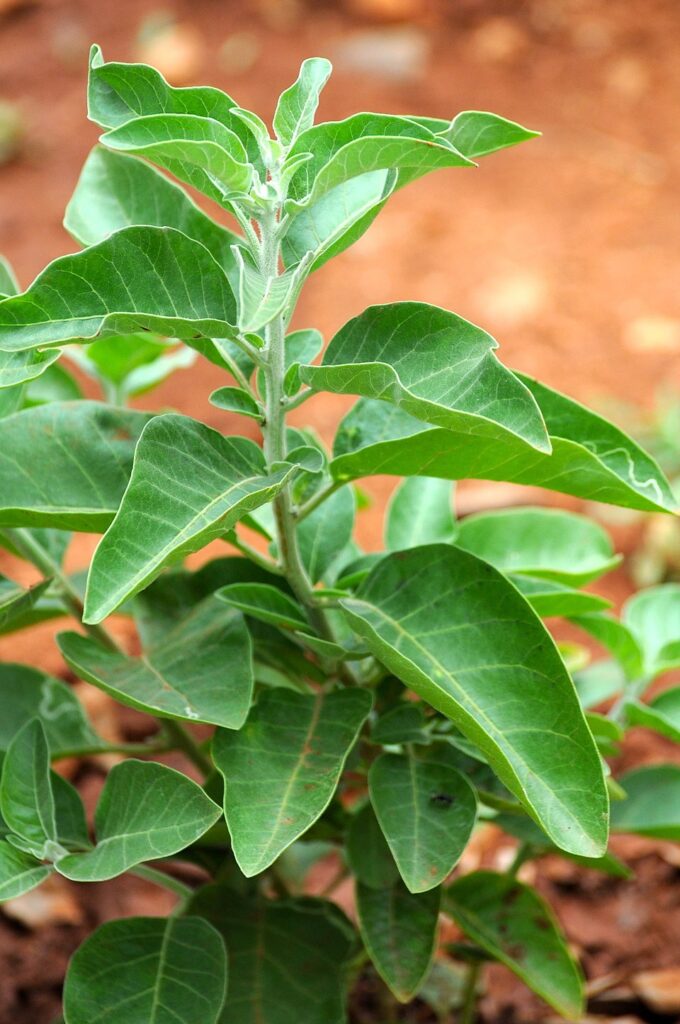
Ashwagandha leaf and root

What are the individual compounds which comprise “total withanolides” printed on millions of product labels worldwide containing that ingredient?

If no one can answer these questions, then that’s the larger problem underneath, bubbling to the surface here.

—–

We also have those who are silently caught in a web. Like those whose science and safety was not on root-only material as previously disclosed — but actually on root+leaf.

This means much of the evidence previously thought root-only actually belongs in the root-and-leaf category.

It also means that consumption of root-and-leaf is much more widespread than previously thought.

And it means that literature used by the Ministry to generate its conclusions has been misclassified, while the misguided claim that root-and-leaf lacks sufficient evidence becomes much weaker.

How many clinicals and safety studies on root-and-leaf is good enough? Does 30+ sound like enough?

—–

Ultimately, whether leaf is added to root or not, the science suggests that the plant-part hullaballoo may be a red herring when it comes to safety.

Thanks to recent published reviews by Thomas Brendler and colleagues, the adverse-event record does not establish causality by either plant part.

And as Mark Blumenthal noted: properly labeled leaf-containing products are not adulterated simply because they contain leaf. As much as the “root-good-leaf-bad” folks would like us to think, there’s no evidence that the leaf is unsafe.

The picture outside of the crucible is actually simple and clear.

We need plant-part disclosure, better identity testing, validated analytical methods, adequately labeled products.

And all of that — not just the parts that people want us to see.

Because these are simple, basic GMP’s which no amount of influence will change.

Article link: https://www.nutraingredients.com/Article/2026/04/28/india-bans-ashwagandha-leaf-use-in-any-form-industry-reacts/