

FDA Infant Formula Testing: Radical Transparency?
May 3, 2026 — Did FDA fulfill its promise on radical transparency on infant formula in the widely promoted Operation Stork Speed?
FDA’s recent infant formula testing results are reassuring. But in my opinion, they’re incomplete.
The agency reports that it tested more than 300 infant formula samples and generated more than 120,000 data points across lead, mercury, cadmium, arsenic, pesticides, glyphosate, glufosinate, PFAS, and phthalates.
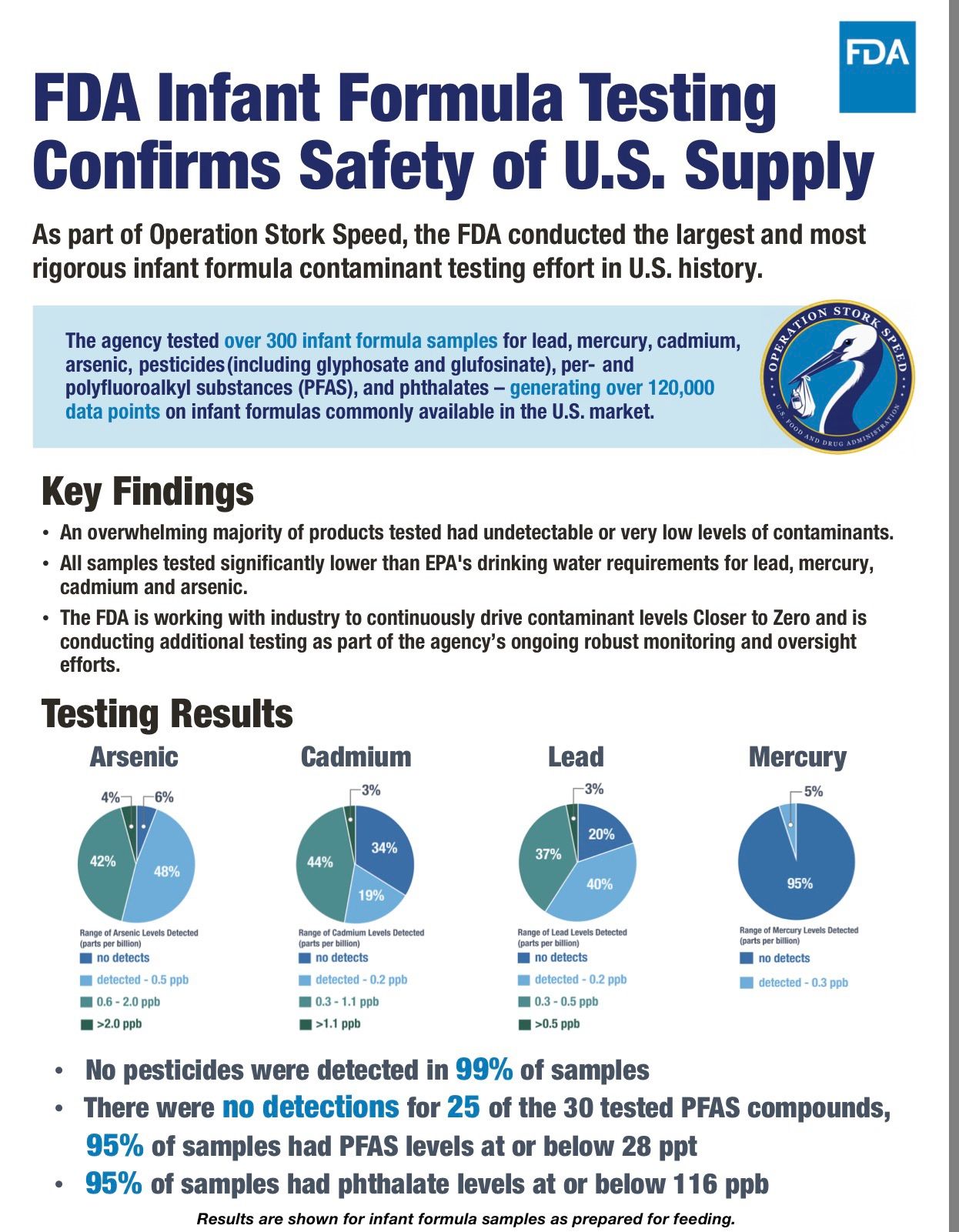
FDA says the overwhelming majority of products had undetectable or very low contaminant levels.
And no glyphosate, surely to the Secretary’s surprise.
That’s great, and kind of what I expected to see.
I don’t understand the rationale behind the study design, however.
Why were 318 pesticides tested, when formula ingredients aren’t considered sources of them?
Was BPA part of the pthalates tested? Did any testing include plastic baby bottle leaching data?
We don’t know.
We do know that infant formula containing cows milk ingredients can contain traces of veterinary antibiotics. Cleaning agents used in processing can contribute perchlorate. Acrylamide was part of prior discussions on infant formula. And does anyone remember melamine and its related nitrogen doping sources?
None of these appear to be included in the testing.
We know that infant formula can be a source of pathogens like Cronobacter and Salmonella — what caused the recent product recalls and shortages.
Why didn’t the study include common pathogens?
We don’t know.
——
Outside of study design, FDA’s communication still falls short of “radical transparency.”
No full report or raw data was provided.
A full report would include methods, detection limits, product and lab identifiers, quality-control data, and statistical treatment. Other than by reference to existing guidances, none of these were provided.
Without details, it’s hard to say that the public can independently evaluate the agency’s conclusions.
That does not mean FDA’s conclusions are wrong. It just means they are not fully verifiable based on what has been released so far.
——
FDA deserves credit for the testing and publishing the broad findings as a summary and fact sheet.
But if the promise was radical transparency, the next step is obvious: publish the full data package, and explain why key contaminants were omitted from the study.
Based on FDA’s summary, there does not appear to have been a broad contaminant crisis in U.S. infant formula, as previously stated by the guy running for President at the time.
There was a need for monitoring and better sharing of data.
But there may also have been a great deal of unnecessary fear.
We don’t know.
When the study design makes sense to food quality folks, and the results are provided as a complete package — maybe we can make a better conclusion then.
FDA Infant Formula Testing Results: https://www.fda.gov/food/infant-formula-homepage/fdas-infant-formula-product-testing-results

Sorry, the comment form is closed at this time.