

Linear Supplement Default, Not Reality
Linear thinking is often our default model of thought. But it’s not reality.
In a supplement formulation meeting many years ago, I suggested to a top supplement brand that cyclical dosing for a certain ingredient would follow the science and might be prudent.
They paused. Looked at me, then at each other. And they changed the subject.
Without a word, I learned in an instant that the nutrition business is much different than the nutrition science.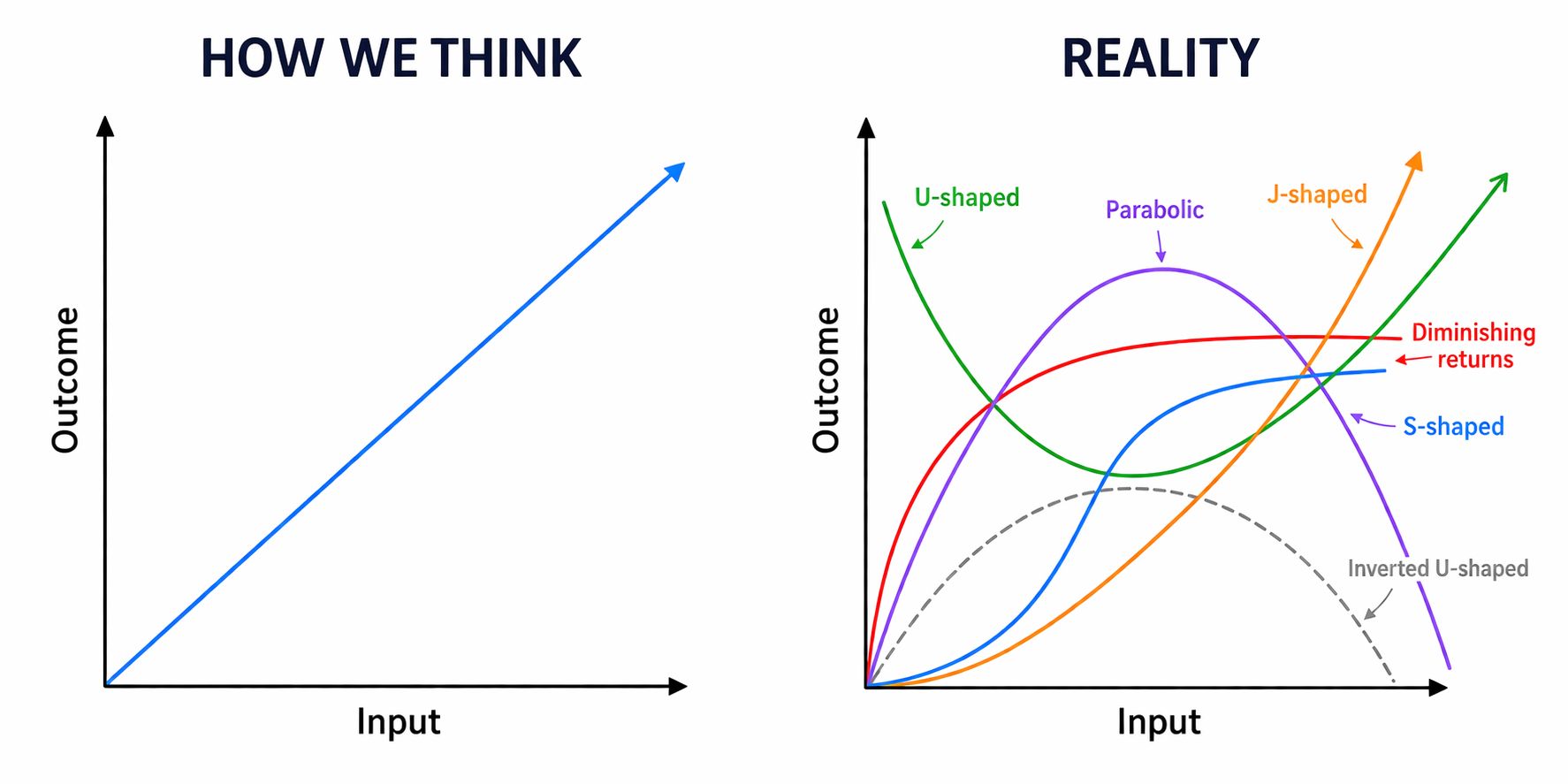
Today, still, wellness solutions are sold with a childish assumption: if some is good, more must be better.
More sun, heat, cold. More magnesium and vitamin D. More water and electrolytes.
On the flip side, if less is good, zero must be great.
Zero sugar. Zero carb. Free from (fill in the blank: _________)
But linear thinking fails for many reasons. Here’s why…
——
First, biology rarely works in straight lines. Too little can hurt you. Enough can help you. Too much can hurt you again. It’s not a straight diagonal line — the outcome as the input increases is parabolic, or some other type of curve.
Second, we are almost never dealing with one variable at a time. We are dealing with many.
More water affects sodium balance. More sodium creates a potassium imbalance. Then we need more water again.
More sun past a certain small amount saturates vitamin D production, while increasing UV exposure and skin cancer risk.
Lower carb intake may help lower blood glucose, but increase fat intake or worsen fiber intake or training output.
More sauna or cold exposure may help at one dose, but reach diminishing returns while piling onto the stresses of everyday life.
That’s what bad health advice leaves out. It treats one input like a lone hero.
Or worse — ‘stacks’ them to no benefit.
—-
Let’s take an example — that ‘everyone’ should supplement magnesium.
There’s some truth in that claim. Magnesium is essential, and some people don’t get enough and benefit from supplementing it.
But that’s not the same as saying everyone needs to take a well-absorbed form of magnesium every day.
And this is where science and sales split.
The science question is: Who actually needs magnesium, in what form, at what dose, for what reason, and for how long?
While the sales question is: How do we turn magnesium into a daily habit for as many people as possible?
—-
Linear thinking for supplements is profitable. Take it every day and keep going, and don’t ever cancel your subscription, because, well… profit margins.
But the science says: The dose-response for magnesium is not a straight line. Magnesium is not a drug. We’re already getting some from our food. Feedback inhibition maintains equilibrium — that’s the ‘expensive pee’ argument.
So the science says cycling or skipping a day or a week occasionally make more sense than the daily status quo.
Yet as many of us are aware, what’s good for science is often bad for business.
This gap in between explains much of where the health and wellness industry misses our mark.

Sorry, the comment form is closed at this time.