

Blake Ebersole on KISC My Health: Trust, Transparency, and the Future of Natural Products
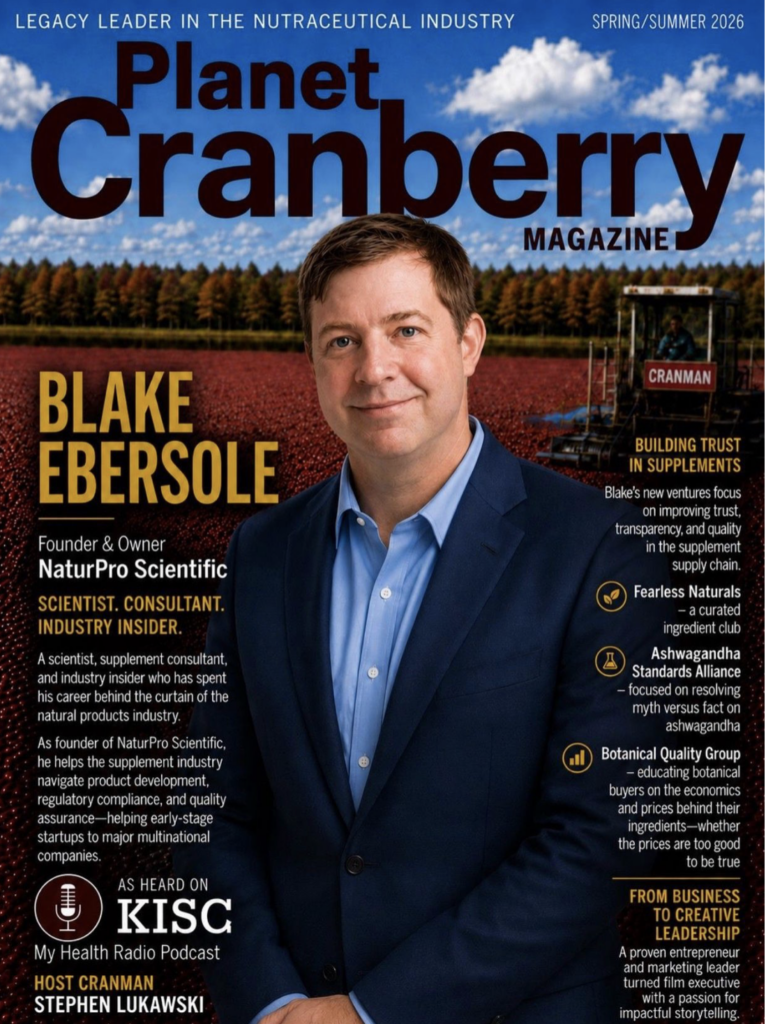
NaturPro Scientific founder Blake Ebersole recently joined Stephen Lukawski, “Captain Cran Man,” and Peter Mingils on the KISC My Health Radio Show for a wide-ranging conversation about the natural products industry, ingredient quality, entrepreneurship, mentorship, and the values that shape meaningful work.
The interview begins with Blake’s personal story: growing up in rural Pennsylvania near Three Mile Island, learning independence and accountability from his family, working in food service at a young age, and developing an early interest in chemistry, health, and the way natural products connect farmers, science, companies, and consumers.
From there, the conversation turns to Blake’s career in the dietary supplement and natural products industry, including the founding of NaturPro Scientific. Blake discusses how NaturPro helps companies navigate product development, formulation, quality assurance, regulatory expectations, supplier qualification, and the difficult but necessary conversations that come with doing things the right way.
A major theme of the interview is trust. Blake explains why the supplement industry needs more transparency around ingredient sourcing, documentation, identity, potency, purity, and supplier practices. He also discusses Fearless Naturals USA, a new documentation-forward ingredient sourcing platform designed to help qualified buyers better understand ingredient quality before making sourcing decisions.
The conversation also explores practical business lessons for supplement brands and ingredient companies. Blake and Stephen discuss why science alone does not sell a product, why marketing and positioning matter, and why companies need to understand competition, pricing, customer acquisition, and the real cost of launching a product.
Later in the interview, Blake reflects on leadership, integrity, and mentorship. He emphasizes that good leadership requires judgment, empathy, listening, and the willingness to ask hard questions. He also encourages younger professionals to learn actively, seek help, build value, and avoid waiting passively for mentorship to appear.
The discussion closes with thoughts on artificial intelligence and the future of work. Blake describes AI as a tool that can accelerate learning, research, analysis, and business decision-making, but not as a substitute for human judgment. Used responsibly, AI can help professionals become better informed, faster, and more capable.
Overall, the podcast is a personal and professional look at the values behind NaturPro’s work: science, transparency, service, independence, and the belief that better information leads to better decisions across the supplement industry.
Listen to the episode:
https://kiscmyhealth.com/kisc-my-health-radio-show-interviews-blake-ebersole-with-captain-cran-man-stephen-lukawski-and-peter-mingils/
The edited transcript below has been cleaned for readability while preserving the substance and tone of the original conversation.
Stephen Lukawski: Blake, welcome to the show. Why did you want to bring your story and your industry experience together in this conversation?
Blake Ebersole: Thank you, Stephen. It is great to be here. This is a chance to bring together where I came from, what shaped me, and what I can do now to help the people who come after us. I have been fortunate to learn from many people in this industry, and I want to use that experience to help others understand the natural products world more clearly.
Stephen Lukawski: Before we go into your childhood and career, tell us about Fearless Naturals. What is the idea behind it?
Blake Ebersole: I have spent much of my career on the technical side of the industry and on the supply chain side. One question comes up again and again: why do poorer quality ingredients keep getting used? We talk about it, we write articles about it, but I wanted to do something practical. The idea behind Fearless Naturals is to create a curated place where buyers can find high-quality ingredients, see the documentation, understand what quality looks like, and make better buying decisions.
Stephen Lukawski: So the goal is to make ingredient quality easier to see and defend?
Blake Ebersole: Exactly. Buyers often have to dig through email chains and ask several rounds of questions before they understand what they are really buying. Too much is hidden. My thought was: let us cut through the noise, break down the silos, and put better quality ingredients and better documentation in one place. We are starting with major, high-demand categories such as cranberry, creatine, collagen, and other top-selling ingredients. The goal is education, transparency, and better sourcing decisions.
Stephen Lukawski: You have said people inside the industry need to talk more openly about what they know. What do you mean by that?
Blake Ebersole: The people who know the back end of the industry, the secrets and the weak spots, need to talk about them. Brands, manufacturers, suppliers, and consumers all benefit when the hidden parts of the supply chain become clearer. A lot of my work now is about education. People cannot make good decisions if they don’t know what questions to ask.
We know what the right thing to do is. Now we have to convince people to do the right thing.
Childhood, Family, and Early Values
Stephen Lukawski: Where did your sense of responsibility and independence come from?
Blake Ebersole: I grew up in Etters, Pennsylvania, a place that isn’t on most maps. By the crow flies, we were about three miles from Three Mile Island. I was very young when the near meltdown happened, but growing up in that community created a deep distrust of power when it’s not accountable. That shaped my sense that people need to do things the right way — and that institutions should not be allowed to abuse trust.
Stephen Lukawski: How did your family background shape you?
Blake Ebersole: My dad’s side is Pennsylvania Dutch Mennonite, and my mom’s side is New York Italian. That combination gave me independence, directness, and a strong sense of truth. We were taught to speak our minds, understand what we were talking about, and try to do the right thing. That has carried through my whole career.
Stephen Lukawski: What was childhood like for you?
Blake Ebersole: I grew up in the country. I didn’t have a lot of toys, video games, or neighbors nearby. I had books, the outdoors, my dog, the creek, my bike, and my imagination. I was introverted and read a lot. We had a television with 13 buttons, and only some of them worked. It was a very different kind of childhood than many kids have now.
Stephen Lukawski: What are some memories that still stand out?
Blake Ebersole: Sports were very important. I played soccer, baseball, wrestling, and football. Being on a team gave me something I did not always have growing up in the country: a group of people my age working toward the same goal, joking around, competing, and trying to get better together. That helped me understand teamwork.
Stephen Lukawski: You also started working very young. What did that teach you?
Blake Ebersole: I started working when I was 13. My dad was general manager of the Country Club of Harrisburg, and that became one of the places where I learned about life. I worked banquets, served members and dignitaries, and worked with people from all kinds of backgrounds. That experience taught me service, discipline, and attention to detail. My dad used to say, your paycheck is your report card for work already done. That stuck with me.
Stephen Lukawski: How did food service influence the way you work now?
Blake Ebersole: In banquets, there is a right way to do things. You serve from the left, pick up from the right, polish the silverware, keep the water glasses full, and make sure the plate looks right before it goes out. It taught me that service is not just about doing the minimum. It is about caring enough to do things correctly and to make the experience better for the person you are serving.
Education and the Path into Natural Products
Stephen Lukawski: How did your education point you toward science?
Blake Ebersole: In high school I loved chemistry. I had great teachers, and chemistry felt like the essence of how the world worked. At the same time, I was interested in justice and crime shows, so I thought about forensic chemistry and even the FBI. That led me to West Chester University, which had a forensic chemistry program.
Stephen Lukawski: Did you enjoy the lab side of chemistry?
Blake Ebersole: I loved the ideas, but I did not always love following lab procedures when the outcome was already known. I wanted to discover new things. Looking back, I probably should have been a better student in some ways, but the curiosity was always there. I wanted to understand why things worked, not just follow instructions.
Stephen Lukawski: Later you earned your MBA at Butler University. Why was that important?
Blake Ebersole: Once I was in the industry, I realized I understood science but needed a better framework for business. Butler was close to home, and my wife supported me the whole way. We went through the MBA program together at night. I chose marketing because I was fascinated by the question of how you communicate the truth and persuade people to make better decisions. Marketing helped me understand awareness, education, persuasion, and calls to action.
Stephen Lukawski: Did you find the natural products industry, or did it find you?
Blake Ebersole: I stumbled into it, but I had always been interested in supplements and natural products. As a kid, I walked past a GNC and saw a poster for Ripped Fuel with a lot of ephedrine in it. I was young and did not understand the science, but with that experience, I understood that supplements could be powerful.
Later, when I saw a job posting for an herbal company, it felt right. I liked the idea that a farmer could grow something that helps the health of a consumer somewhere else in the world. If we can support the farmer and support the consumer, that is a win-win.
AHPA, Mentors, and Industry Standards
Stephen Lukawski: How did you become involved with the American Herbal Products Association?
Blake Ebersole: I was technical director at a company and was traveling to India, working on GMP systems, NSF certification, and selling ingredients to large companies. My company encouraged me to attend AHPA meetings. That is where I found people who were trying to do the right thing: creating standards, educating the industry, and bringing science to herbal products.
Stephen Lukawski: Michael McGuffin had a major influence on the herbal products industry. What did he mean to you?
Blake Ebersole: I looked up to Michael. He helped build AHPA from very small beginnings into an organization that could create standards and credibility for herbal products. If he were here, I would say thank you, and I would tell him we will keep tending the garden. AHPA is still strong, and the work continues through the people carrying that legacy forward.
Stephen Lukawski: How did AHPA make you better?
Blake Ebersole: AHPA was priceless for me. In a company, you learn from the people immediately around you. In an association, you learn from people across many companies and disciplines. Committee meetings exposed me to people with more experience and different perspectives. I learned by listening to how they asked questions, solved problems, and worked toward shared goals.
NaturPro Scientific and Consulting with Integrity
Stephen Lukawski: How did NaturPro Scientific begin?
Blake Ebersole: After about 10 years in supplements, I wanted to grow and challenge myself. My first consulting opportunity was in cannabis, which was an emerging industry that badly needed standards. From there, I quickly realized I needed to branch out and understand more parts of the natural products business. Over the past 11 years, I have worked with close to 300 clients, from tiny startups to Bayer Healthcare.
Stephen Lukawski: What has consulting allowed you to do?
Blake Ebersole: Consulting has allowed me to help many different kinds of companies and to stand up for the right thing in different settings. I have worked on product development, quality, compliance, formulation, expert witness work, and a wide range of technical problems. I have often had to ask myself whether I was ready for a challenge, but I learned that just because you haven’t done something before doesn’t mean you can’t learn how to do it.
Stephen Lukawski: How do you handle the fact that technical advice can sometimes be uncomfortable for clients?
Blake Ebersole: As a technical, quality, and regulatory person, I often have to tell people things they don’t want to hear. That can make conversations uncomfortable. Over time, I have learned to sense whether someone truly wants to understand the right thing to do — or whether they simply want someone to sign off on something. We aren’t right for everyone, but the people we are right for tend to stay with us, refer us, and value the work.
Stephen Lukawski: You have strong views about conflicts of interest in consulting. Why?
Blake Ebersole: If you are working for the client, you should not also be taking a cut from the vendor. That is a conflict of interest. It sacrifices integrity and judgment. From the beginning of NaturPro, I said I would not do that, and it remains one of our values.
Stephen Lukawski: What have you learned about people in business?
Blake Ebersole: Most people are good and well-meaning, but everyone has self-interest. You have to provide real value. You can’t overcharge, nickel-and-dime, or expect people to come back if you don’t serve them well. Not every prospect is a good fit. But for those who are, I want to do the best possible work.
Advice for Younger Professionals
Stephen Lukawski: What advice would you give people starting out in the natural products industry?
Blake Ebersole: Work as hard as you can and learn as much as you can. Don’t feel entitled to anything. Nobody is granted anything. You have to show your value. Sometimes that means getting out of your comfort zone. If you know more than anyone else on your team about a topic, don’t be afraid to become the person who leads on that topic.
Stephen Lukawski: How should younger professionals think about personal brand and visibility?
Blake Ebersole: Personal brand is not only about posting on LinkedIn. I didn’t start doing that until later in my career. It can also mean being the person internally who asks good questions, thinks independently, and isn’t simply a yes-person. Being willing to ask the hard questions, and not just go along with what the boss says, is how people learn that you are reliable.
Stephen Lukawski: How do you balance authenticity with professional risk?
Blake Ebersole: Authenticity requires judgment. You have to ask what the purpose is, why it matters, and who it may upset. I can say more now because I don’t report to anyone else, but I still weigh those things. When nobody else is saying something and somebody needs to say it, I’m willing to say it. But authenticity doesn’t mean being a constant complainer. It means standing up when it matters.
Stephen Lukawski: How important is open-mindedness?
Blake Ebersole: It is critical. I have strong opinions, but sometimes someone else says something that weakens or changes my opinion. You have to be willing to listen. Strong opinions without open-mindedness are a dangerous combination.
Marketing, Product Reality, and Competition
Stephen Lukawski: What do companies often misunderstand about selling science-based ingredients?
Blake Ebersole: Companies often think science will sell itself. But it doesn’t. Promotion has to come with the product. In today’s market, people may need to hear about something eight or 10 times before it sticks. You can have the best product in the world, but if nobody’s heard of it, it won’t matter.
Stephen Lukawski: What do product startups need to understand before launching?
Blake Ebersole: They need to understand the financial reality. I ask clients about their marketing budget because you can’t simply create a product and expect people to beat down your door. In many cases, marketing may be at least half of the operating budget. I’ve seen great products fail because the founders didn’t plan for competitive positioning, promotion, and customer acquisition.
Stephen Lukawski: How should companies think about competition?
Blake Ebersole: You have to be objective. Tools like the four Ps, SWOT analysis, and Porter’s Five Forces exist for a reason. We can’t control the economy, regulations, or the competitive landscape, but we have to acknowledge them. In supplements, competition is often the major killer. Your competitor is not only the top-selling brand — it may be hundreds of other brands selling magnesium, greens powders, mushrooms, or whatever category you are in.
Stephen Lukawski: What about ingredient companies that try to launch their own consumer brands?
Blake Ebersole: It can work, but being good at one part of the business doesn’t mean you will automatically be good at another part. Controlling the supply does not mean you know how to market to consumers, manage customer acquisition costs, optimize ad spend, or build a consumer brand. Some companies can do both, but the failure rate is high. It’s hard enough to be a good ingredient supplier or a good brand. Doing both is much harder than people think.
Leadership and Team Culture
Stephen Lukawski: What qualities make a great leader today?
Blake Ebersole: Leadership starts with judgment. You need facts, patience, and the ability not to jump to conclusions. I learned a lot from watching my dad lead in a premium service business with a transient workforce. He had to be relatable, open, analytical, and practical. That shaped the way I try to lead and advise clients: use good judgment, don’t jump to conclusions, and speak up when needed.
Stephen Lukawski: Where do empathy and listening fit into leadership?
Blake Ebersole: They’re integral. You can’t assume you know what someone else is dealing with or why something happened. With a few questions and an open mind, you often discover the real situation. Empathy may be the number one quality of a leader today. The best leaders aren’t just command-and-control personalities. They listen, learn, and use judgment rather than power.
Stephen Lukawski: How do you think about integrity?
Blake Ebersole: Integrity is everything. If people can’t trust you, if you overpromise and underdeliver, or if you aren’t reliable, people won’t include you in important work. You have to stand up, do your best, and come through for the team. You may never be great at everything, but you should keep trying to become more capable and more useful.
Stephen Lukawski: How do you recognize a healthy team?
Blake Ebersole: As a consultant, I get to see many different teams. One of my indicators of a strong team is whether people are willing to disagree with each other. If people are afraid to speak up, the team is in trouble. If people can offer different points of view and still work toward the goal, that is usually a good sign.
Mentorship and Lessons for a Younger Self
Stephen Lukawski: How important has mentorship been in your career?
Blake Ebersole: I did not come through a formal corporate training program, so much of my development came from doing the job, watching others, and learning by example. That worked, but it did not have to be so hard. Programs like SupplySide Fresh are valuable because they help new people understand the industry faster. Being a mentee should be active, not passive. Don’t simply wait to be taught. Watch, listen, ask, and learn from people who have more experience.
Stephen Lukawski: Are experienced people generally willing to help?
Blake Ebersole: Many are. I am not naturally the type of person who asks for help, but when people ask me for help, I like giving my time. People with experience are often willing to answer questions. You just have to reach out and ask. I wish I had done more of that earlier in my career.
Stephen Lukawski: What would you tell your younger self?
Blake Ebersole: I would say, don’t try to do so much on your own. Lean on other people. Ask for help. I was independent and a quick learner, but I would have benefited from taking better advantage of the people around me who knew more than I did.
AI and the Future of Work
Peter Mingils: AI is becoming a major topic for students and professionals. How is it influencing your work?
Blake Ebersole: I use AI daily. Even with 20 years in the industry, I find it useful for synthesizing the full picture, testing my thinking, and helping me understand complex topics faster. But I never treat the output as final. I use lines of questioning, starting with one question and then building from there. You can’t ask one question and expect the answer to be complete.
Peter Mingils: What should people be careful about?
Blake Ebersole: AI can accelerate knowledge, but it has limits. It can help you learn faster than searching randomly or taking a class on everything, but everyone else has access to the same tools. That means you have to raise your game. You also have to be critical. AI is designed to be helpful and agreeable, so you cannot treat it as the final authority. It should be one part of your total process for getting to the right answer.
Stephen Lukawski: How do you see AI affecting business decisions?
Blake Ebersole: AI makes it harder to excuse uninformed decisions. A product developer or marketer can now analyze positioning, pricing, competitors, and claims much faster than before. But it still requires human judgment because you need to know the right metrics and criteria. Yet AI can make the analysis better and faster. In that sense, it can make capable people even more capable.
Stephen Lukawski: Any final thoughts on AI and the future?
Blake Ebersole: We are on the cusp of a new world in work and life. AI will change the capabilities of the people I already want around me. I don’t see it simply as replacing people. I see it as making people better and challenging everyone to become the best person they can be. It can help us help the world and make a living at the same time — but only if we use it with judgment.
Closing
Stephen Lukawski: Blake, thank you for sharing your story and your work.
Blake Ebersole: Thank you, Stephen. I really appreciate the opportunity. Not many people ask me where I came from, so it has been meaningful to share that and have it out there. We’re only as good as the people around us, and I appreciate being part of this conversation.

Sorry, the comment form is closed at this time.