
Call us toll free: (317)727-9173
Top notch Multipurpose WordPress Theme!

The Ashwagandha-AYUSH Truth Will Set Us Free

by NaturPro in Uncategorized Comments: 0

The truth will set us free.

Many are interpreting the AYUSH/FSSAI action differently than it actually is.

The Ashwagandha Standards Alliance, a robust, growing group of responsible firms, is addressing these and other related issues one by one.

Undeclared aerial-part substitution should be taken seriously. Yet ashwagandha ingredients from reputable suppliers already properly label plant part as part of GMP — so this looks like a bit of a red herring for other issues.

The action is also being interpreted as a regulatory restriction applying to countries outside India, when it is only a continuation of a misguided 2021 advisory and 2024 scientific reviews.

Ashwagandha Standards, Not Slogans

As a regulatory decision within India’s own traditional medicine and food framework, the ruling should not be misread anywhere else as a global scientific verdict that ashwagandha leaf is unsafe.

Overall, the action is misguided in a few ways.

First, the action conflates legitimate use of root and leaf with adulteration. “Adulteration” is a legal and regulatory definition and should not be thrown around casually.

The truth is, more than 30 clinical and safety trials have been conducted on properly labeled root+leaf products, showing an excellent record of safety and efficacy.

Second, the action neglects the body of evidence, recently compiled and published in Phytotherapy Research by Thomas Brendler and others, which shows an excellent record of safety for both root and leaf ashwagandha products.

Third, the action is based on a foundation of flawed, incomplete AYUSH-generated reports which omit a large amount of verified evidence, including the incorrect attribution of root-and-leaf evidence as root-only.

Fourth, the common argument that leaf was not used traditionally is incorrect. Tallon, Koturbash, and Blum’s 2025 systematic review in Phytotherapy Research catalogued leaf and aerial-part use across multiple traditional systems, including uses for fever, inflammation, wound poultices, and febrifuge applications in regional materia medica across India, Yemen, Ethiopia, Sudan, Jordan, the Sahel, South Asia, and other areas.

That does not mean all traditional leaf use automatically supports modern dietary supplement use — but that’s what we have scientific support for.

(When we have the science, how much of a difference does an already-incomplete historical record make?) Yet we are aware that any “no historical precedent” claim for leaf is incorrect and misguided.

The Ashwagandha Plot Bubbles and Thickens

by NaturPro in Uncategorized Comments: 0

The ashwagandha plot bubbles and thickens, and the crucible now precipitates visible impurity.

The Ashwagandha Standards Alliance applauds NutraIngredients for yesterday’s article by Asia Sherman, which illustrates all together the stark contrast between one popular narrative and the science.

The narrative says that root is authentic, that leaf is suspect, and that the Ministry of Ayush ban is a necessary correction.

But the science says something much different.

And to me, the real issue here is distraction without full disclosure — on multiple levels.

—–

First, we have those who drive the narrative, claiming that integrity is everything. If that’s so, then why is no one able to verify the composition of their products as they are labeled?

When a supplier states ‘root-only’, what does that really mean?

Ashwagandha leaf and root

What are the individual compounds which comprise “total withanolides” printed on millions of product labels worldwide containing that ingredient?

If no one can answer these questions, then that’s the larger problem underneath, bubbling to the surface here.

—–

We also have those who are silently caught in a web. Like those whose science and safety was not on root-only material as previously disclosed — but actually on root+leaf.

This means much of the evidence previously thought root-only actually belongs in the root-and-leaf category.

It also means that consumption of root-and-leaf is much more widespread than previously thought.

And it means that literature used by the Ministry to generate its conclusions has been misclassified, while the misguided claim that root-and-leaf lacks sufficient evidence becomes much weaker.

How many clinicals and safety studies on root-and-leaf is good enough? Does 30+ sound like enough?

—–

Ultimately, whether leaf is added to root or not, the science suggests that the plant-part hullaballoo may be a red herring when it comes to safety.

Thanks to recent published reviews by Thomas Brendler and colleagues, the adverse-event record does not establish causality by either plant part.

And as Mark Blumenthal noted: properly labeled leaf-containing products are not adulterated simply because they contain leaf. As much as the “root-good-leaf-bad” folks would like us to think, there’s no evidence that the leaf is unsafe.

The picture outside of the crucible is actually simple and clear.

We need plant-part disclosure, better identity testing, validated analytical methods, adequately labeled products.

And all of that — not just the parts that people want us to see.

Because these are simple, basic GMP’s which no amount of influence will change.

Article link: https://www.nutraingredients.com/Article/2026/04/28/india-bans-ashwagandha-leaf-use-in-any-form-industry-reacts/

How to Choose Supplements Like an Expert (SuppCo Podcast)

by NaturPro in Uncategorized Comments: 0

Posted by Supp.Co, April 22, 2026 — The supplement industry has a quality problem. Not a shortage of it. A definition problem. Every brand claims it. Almost none of them mean the same thing.

(Read the full article here.)


“Quality is like an onion with a thousand layers. By the time you get to the core, you’ve shed a few tears, because you’ve seen how things really work.”


I sat down with Blake Ebersole to talk about what quality actually means when you strip away the marketing. Blake has spent more than two decades on the back end of this industry: reviewing labels, qualifying ingredient suppliers, auditing manufacturers, and building the kind of specifications that most brands don’t know exist. What he described is a system so layered and so poorly understood by most people operating inside it that the word “quality” has become almost meaningless.

Here’s what I took away.

Quality Is a Checklist… a Very Long One

Blake doesn’t think in abstractions. He thinks in checkboxes.

Good Manufacturing Practices alone carry roughly 300 checkboxes mandated by FDA regulations. Label compliance adds another 100, down to the precise thickness of the lines in your Supplement Facts panel, which most companies get wrong because the regulation exists but isn’t commonly enforced. Ingredient specifications for botanicals can add 200 more. Supplier qualification: another 150.

By his count, a truly rigorous quality framework has around 1,000 checkboxes. A typical Amazon-seller brand checks maybe 50 of them. Not because they’re trying to cut corners, but often because they don’t know the other 950 exist.

Full video “How To Choose Supplements Like an Expert” here.

He breaks the industry into four tiers. Most brands fall into tier one or two: either well-intentioned but undereducated, or roughly FDA-compliant but missing the depth. Tier three is the established players who know what they’re doing but rely heavily on outside consultants and still have gaps. Tier four, the true one-percenters, are companies like Amway Nutrilite, who have full testing systems, institutional knowledge built over decades, and enough scale that a single screw-up becomes an existential risk.

Most of what you see on shelves is tier two.

Where Good Intentions Break Down

The supplement supply chain has at least three links before a finished product reaches you: ingredient supplier, possibly a distributor, then a contract manufacturer, then the brand whose name is on the label. At each handoff, quality requirements only flow as far as the knowledge of the buyer.

If a brand doesn’t know what a proper ingredient specification looks like, that gap travels all the way back to the raw material.

Blake’s most common citation from FDA audits and warning letters: specifications and identity testing. The issue with specifications isn’t usually what’s on them. It’s what’s missing. A short spec for green tea extract might look fine on its face. But if you don’t know what should be there, you don’t know what’s absent. Most brand owners aren’t green tea extract experts. Nobody can be an expert in every ingredient.

Identity testing has its own games. Some companies send the same sample to multiple labs and keep the result that passes. Others use their supplier’s test as their own verification without running it independently. There’s no system-level control against either practice.

Botanicals Are a Different Beast

Single-molecule ingredients, vitamin C and magnesium glycinate for example, are relatively straightforward to specify and test. Botanicals are not.

A botanical isn’t one molecule. It’s a mixture of tens of thousands of compounds. Blake’s analogy: you can manage one or two kids at home. Try being a principal managing a thousand who are fighting each other and going missing. That’s botanicals.

Specifications for a botanical ingredient are often three to four times longer than for a synthetic vitamin. You’re measuring marker compounds for potency, screening for adulterants, testing for pesticide residue, and trying to confirm identity in a matrix that can vary significantly between batches, farms, and seasons.

Adulteration in this category is common, but it’s not always malicious. The most frequent form is economically motivated dilution: adding starch or maltodextrin to an extract to pad volume and margin. Starch is actually quite difficult to detect chemically, which is part of why it’s so commonly used. The consumer ends up with a product that looks right on the label but doesn’t deliver the potency they’re paying for.

The worst adulteration isn’t the deceptive kind. It’s the accidental kind. An undeclared allergen from a labeling error. That can kill someone.

What Can Go Wrong in Manufacturing

Even when a brand starts with high-quality raw materials, problems can emerge at every stage of production. Blake broke it down clearly:

  • Farm level: Drying and milling often happen at separate facilities, meaning the ingredient changes hands before it ever reaches a manufacturer. Salmonella and other pathogens can be introduced here, and insufficient processing later won’t catch them.
  • Shipping and storage: Raw materials are sometimes transported overseas between processing steps. Temperature, humidity, and handling during transit can all degrade quality in ways that aren’t visible in a finished product test.
  • Contract manufacturing: Most brands don’t manufacture their own products. Their contract manufacturer has 200 other customers. The brand assumes their standards are being applied, often without any verification mechanism in place.
  • Final testing: A manufacturer can test a batch, get a negative result for pathogens, and still ship a product that causes illness. That’s not a system failure. It’s the nature of sampling in large-volume production. One drum can test clean while the one next to it is contaminated.

When something goes wrong, the FDA warning letter goes to the brand, not the manufacturer. The brand’s name is on the label. That association lives in the public record indefinitely.

The Processing Paradox

There’s a widely held belief in wellness culture that less processing is always better. Blake pushes back on this hard.

Processing exists, first and foremost, to make things safe. Cooking, drying, acidifying, milling: these aren’t modern interventions. Humans have been dehydrating and grinding botanicals for 40,000 to 50,000 years.


His clearest example: greens powders. Consumers want a vibrant green product because green signals “fresh” and minimally processed. 


But chlorophyll is unstable; heat degrades it. So manufacturers under-process to preserve color, and in doing so they sacrifice food safety. Salmonella can be present in raw greens at the farm level, sometimes as an endophyte living inside the seed itself. Insufficient heat doesn’t kill it. A bright green greens powder is actually a prompt to look more closely at that brand’s food safety protocols, not a reassurance.

Third-Party Testing Is Not a Gold Standard

“Third-party tested” has become the default quality signal for consumers and retailers. Blake respects the concept. He has serious concerns about how it plays out in practice.

Labs are businesses. They compete on price. An HPLC test for $50, a price point he’s seen in cannabis testing, is not running the controls between runs that ensure the equipment is working correctly. Someone on the brand or manufacturer side has to actually understand what good testing looks like to evaluate whether they’re getting it.

ISO 17025 certification, now required by Amazon, is a step up. But it only covers validated methods at that lab, and many labs don’t validate their methods for the specific product matrix they’re testing. Turmeric is antimicrobial. If the test doesn’t account for that, the turmeric can suppress the pathogen in the sample and the product registers as clean even when it isn’t.

His rule: the lab report should state not just that the lab is ISO certified, but that the specific method used is ISO certified. That’s a much shorter list.

What You Can Actually Do

Blake’s practical framework for consumers:

  • Learn what a compliant label looks like. Use an established brand like NOW Foods as a reference. If a label looks different in structure or formatting, that’s worth a closer look.
  • Buy from large, established brands. Companies that have survived FDA scrutiny and built institutional knowledge over decades are operating differently than a two-year-old brand.
  • Price signals matter. A $20 multivitamin is almost certainly cutting somewhere. Compare cost per capsule at equivalent dosages. In this industry, there are no real deals.
  • Watch the claims. Vague mechanism-of-action language is often a sign that there’s no clinical evidence behind the product. Companies lean on it because it’s harder to enforce.
  • Invest time proportional to what you’re investing in. If you spend ten hours a week on fitness, spending five minutes picking a supplement is a mismatch.

Watch the full conversation with Blake above for more on the supply chain opacity problem, what a proper ingredient specification actually looks like, and his take on the botanical formulation he helped develop that he thinks deserves more attention.

Before I Knew Any Better…

by NaturPro in Uncategorized Comments: 0

Back before I knew any better, I thought natural products were easy.

I used to think sourcing was easy.

Find a supplier online. Get a spec sheet. Allergen statement, SDS. Done.

Then you learn that “same ingredient” can mean different countries, different processing, different adulteration risks, different documentation, different actual quality.


I used to think testing was easy.

Send it to a lab. Get a number. Problem solved.

Then you learn the method might not fit the ingredient. The sample might not represent the lot. The result might look scientific and tell you almost nothing useful.

That’s before you test out-of-spec for a $50,000 batch of material that everyone else is dying to accept on deviation.

——

I used to think labels were easy.

Just say what it is, what it does and move on.

Then you learn how many products are built backwards — marketing first, evidence later, labels last. Fancy claims with weak support.

And a whole lot of crossed fingers riding on the label review.

——

I used to think GMPs were easy.

Follow the rules. Check the boxes. Keep going.

Then you learn that minimum compliance and actual quality are not the same thing. A check-box is left to interpretation, and a lot of people can survive the thin cross-section of an audit.

Seldom are systems built and maintained that consistently prevent problems.

——

I used to think product success was easy.

Good ingredient. Good packaging. Good story. Launch it.

Then you see a thousand similar products on Amazon. You walk the closeout aisle and see the markdown graveyard. Or the dusty tops of near-expired units.

All filled with big promises that no one cared about.

——

A lot of things look easy from far away.

Especially in supplements, food and cosmetics.

But the longer you do this, the more respect you gain for the boring parts. The questions, the methods, the documentation.

And especially the judgment and the restraint.

Without that respect and that experience, it’s easy to call failure a surprise.

I Wish I Had SupplySide Fresh

by NaturPro in Uncategorized Comments: 0

Once upon a time, I was fresh.

Today, I wish I had SupplySide Fresh — an industry onboarding program for new hires and newcomers to the health and nutrition industry. Learn from me and other experts, build valuable connections and accelerate growth in this dynamic field.

Why choose SupplySide Fresh?

Comprehensive education

Learn from industry experts through curated sessions covering key topics, including trends, regulations and important partnerships.

Networking and community building

Networking and community building: Build meaningful connections with peers, mentors and industry leaders, both online and in person.

Tailored for newcomers

Whether you’re starting a new career or transitioning into a new role, SupplySide Fresh will help you navigate the industry’s complexities and accelerate your success.

SupplySide Fresh is designed to help newcomers — and professionals stepping into new roles — get up to speed quickly in the nutrition industry. The program combines online education, practical industry context, and virtual and in-person networking to help participants understand how the industry works, who the key players are, and what knowledge is needed to contribute with confidence.

The program offers two course tracks: Food & Beverage and Supplements. Each track is built around curated educational modules covering industry resources, business operations, supply chains, due diligence, legal and regulatory basics, trends, partnerships, and networking. The supplement course includes topics such as adulteration risk, clinical trials, supplement quality, GMPs, labeling and claims, GRAS vs. NDI, and DSHEA history.

For companies, SupplySide Fresh can serve as a structured onboarding tool for new hires, helping reduce ramp-up time and provide consistent baseline training across teams. For individuals, it offers a practical entry point into a complex industry, with on-demand learning, optional quizzes, networking opportunities, and a certificate of completion co-branded with Sonoran University of Health Sciences.

The value of SupplySide Fresh is that it does not treat the nutrition industry as a simple product category. It recognizes that success in supplements, functional foods, beverages, and ingredients requires understanding regulation, quality, science, manufacturing, marketing, trade media, testing, claims, supply chains, and relationships. In other words, it is not just a course. It is an industry orientation.

For anyone entering the nutrition industry — whether through sales, marketing, quality, regulatory, R&D, operations, investment, entrepreneurship, or brand leadership — SupplySide Fresh provides a practical foundation for learning the language, avoiding common blind spots, and building the relationships needed to grow.

https://supplysidefresh.com/

hashtag#supplysidefresh hashtag#healthandnutrition hashtag#industryeducation hashtag#professionalnetworking

Linear Supplement Default, Not Reality

by NaturPro in Uncategorized Comments: 0

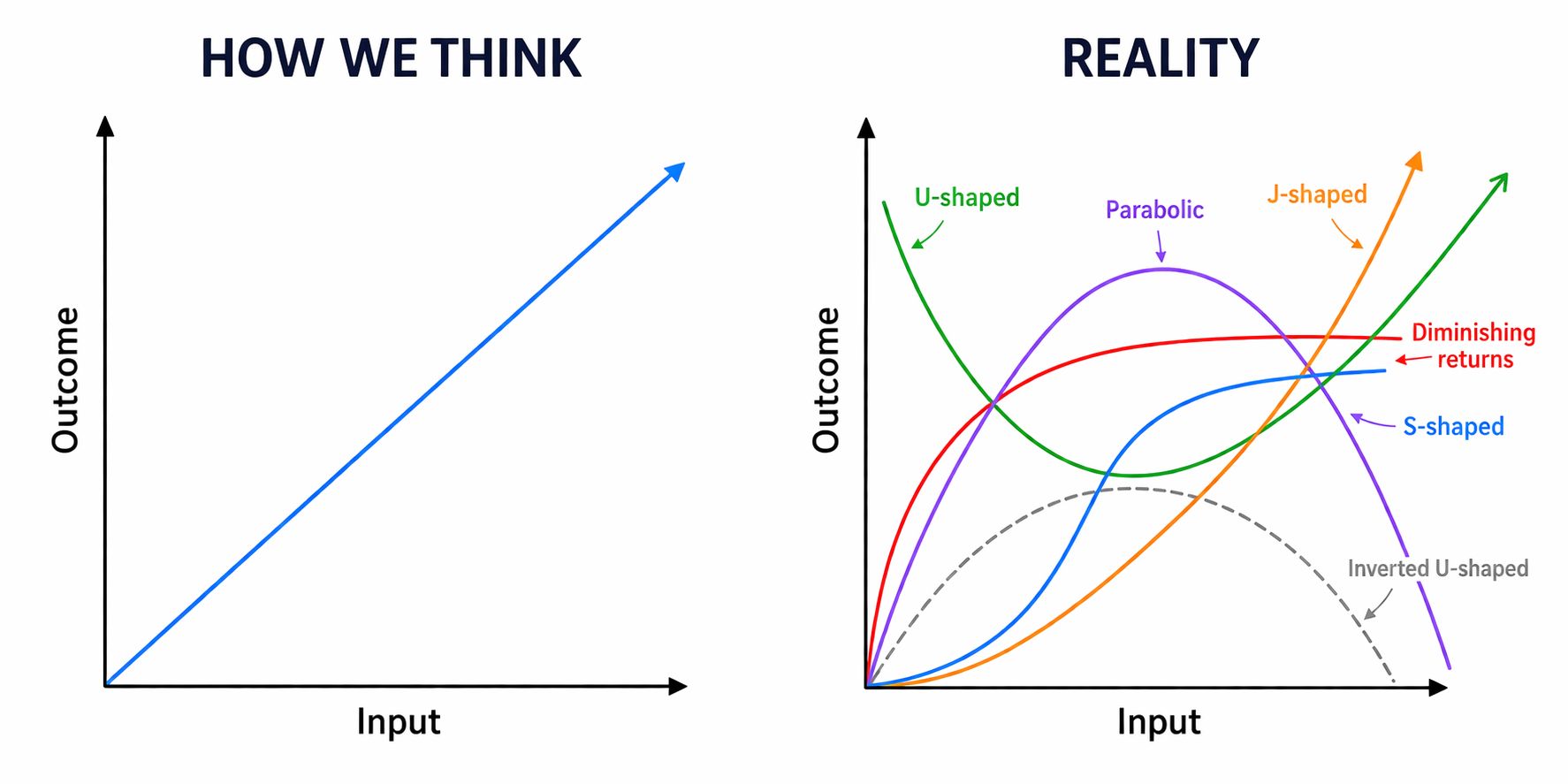
Linear thinking is often our default model of thought. But it’s not reality.

In a supplement formulation meeting many years ago, I suggested to a top supplement brand that cyclical dosing for a certain ingredient would follow the science and might be prudent.

They paused. Looked at me, then at each other. And they changed the subject.

Without a word, I learned in an instant that the nutrition business is much different than the nutrition science.


Today, still, wellness solutions are sold with a childish assumption: if some is good, more must be better.

More sun, heat, cold. More magnesium and vitamin D. More water and electrolytes.

On the flip side, if less is good, zero must be great.

Zero sugar. Zero carb. Free from (fill in the blank: _________)

But linear thinking fails for many reasons. Here’s why…

——

First, biology rarely works in straight lines. Too little can hurt you. Enough can help you. Too much can hurt you again. It’s not a straight diagonal line — the outcome as the input increases is parabolic, or some other type of curve.

Second, we are almost never dealing with one variable at a time. We are dealing with many.

More water affects sodium balance. More sodium creates a potassium imbalance. Then we need more water again.

More sun past a certain small amount saturates vitamin D production, while increasing UV exposure and skin cancer risk.

Lower carb intake may help lower blood glucose, but increase fat intake or worsen fiber intake or training output.

More sauna or cold exposure may help at one dose, but reach diminishing returns while piling onto the stresses of everyday life.

That’s what bad health advice leaves out. It treats one input like a lone hero.

Or worse — ‘stacks’ them to no benefit.

—-

Let’s take an example — that ‘everyone’ should supplement magnesium.

There’s some truth in that claim. Magnesium is essential, and some people don’t get enough and benefit from supplementing it.

But that’s not the same as saying everyone needs to take a well-absorbed form of magnesium every day.

And this is where science and sales split.

The science question is: Who actually needs magnesium, in what form, at what dose, for what reason, and for how long?

While the sales question is: How do we turn magnesium into a daily habit for as many people as possible?

—-

Linear thinking for supplements is profitable. Take it every day and keep going, and don’t ever cancel your subscription, because, well… profit margins.

But the science says: The dose-response for magnesium is not a straight line. Magnesium is not a drug. We’re already getting some from our food. Feedback inhibition maintains equilibrium — that’s the ‘expensive pee’ argument.

So the science says cycling or skipping a day or a week occasionally make more sense than the daily status quo.

Yet as many of us are aware, what’s good for science is often bad for business.

This gap in between explains much of where the health and wellness industry misses our mark.

Food Science is Not Broken

by NaturPro in Uncategorized Comments: 0

Food science is not broken. But people keep treating it like it is finished.

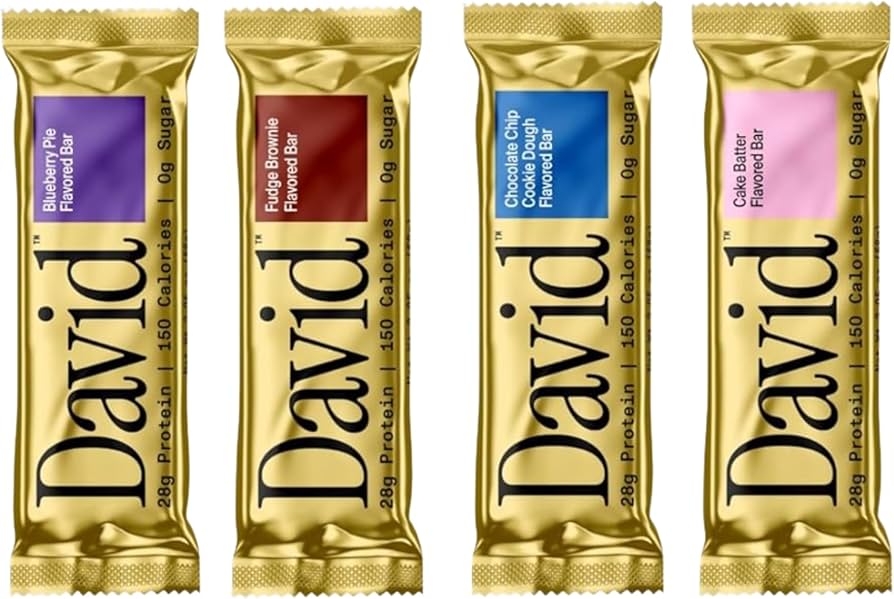
I was quoted this week on the David bar lawsuit, and the bigger issue is not just a protein bar. It is partly about how badly people want to call a single scientific method a gold standard, when it might just be an old standard.

Science advances, and so should humans.

—–

AOAC 945.44, titled “Fat (Crude) in Food — Acid Hydrolysis Method” is a gravimetric method. You add acid to the sample, then you extract the fat with a nonpolar solvent and weigh the result. Sounds easy, right?

Wrong. If a fat in a food is bound by protein, it might not get extracted and the result underestimates. If the food has naturally occurring waxes, sterols or other non-fat hydrophobic substances, it falsely counts those as fat and overestimates. The results all depend on the matrix – or the specific composition of what’s being tested.

The crude fat method was also developed for an earlier era of food, before ingredients and products that defied the limits of older assumptions. It doesn’t make AOAC 945.44 worthless — it just means it’s not automatically the right method for every sample.

Same with running bomb calorimetry for calories. It’s just the old standard, not the gold standard.

David Bar food testing lawsuit based on gold standard, not old standard

Today, we’ve got more specific methods that blow gravimetry and calorimetry out of the water in terms of accuracy and precision. But the lab will run whatever test you order – so you have to order wisely.

We can still run the old method to see how its results compare to the new methods. But don’t jam everything imaginable through the old methods and expect to have perfect results.

This is is how science is supposed to work. It advances, refines and updates when old tools prove insufficient. So today, we’ve got better tools to measure fat and calories — compositional analysis, ingredient-specific metabolic data, and FDA-compliant flexibility to the science — all allowed under 21 CFR 101.9.

Wilbur O. Atwater would be proud of where we are. And I’m guessing that would probably shame anyone who oversimplifies his 4-4-9 and picks gravimetry over the tools we have at our disposal today to get a splashy, cheap and fast answer.

Food science is like every other scientific discipline. It keeps moving.

The question is not whether an old method was once respected and most commonly used. It is whether it is still the right one now, fit for purpose to the matrix.

Article in Nutritional Outlook: https://www.nutritionaloutlook.com/view/david-protein-faces-class-action-over-caloric-and-fat-labeling-accuracy

32 Years After DSHEA, FDA Debates Meaning of “Dietary Substance”

by NaturPro in Uncategorized Comments: 0

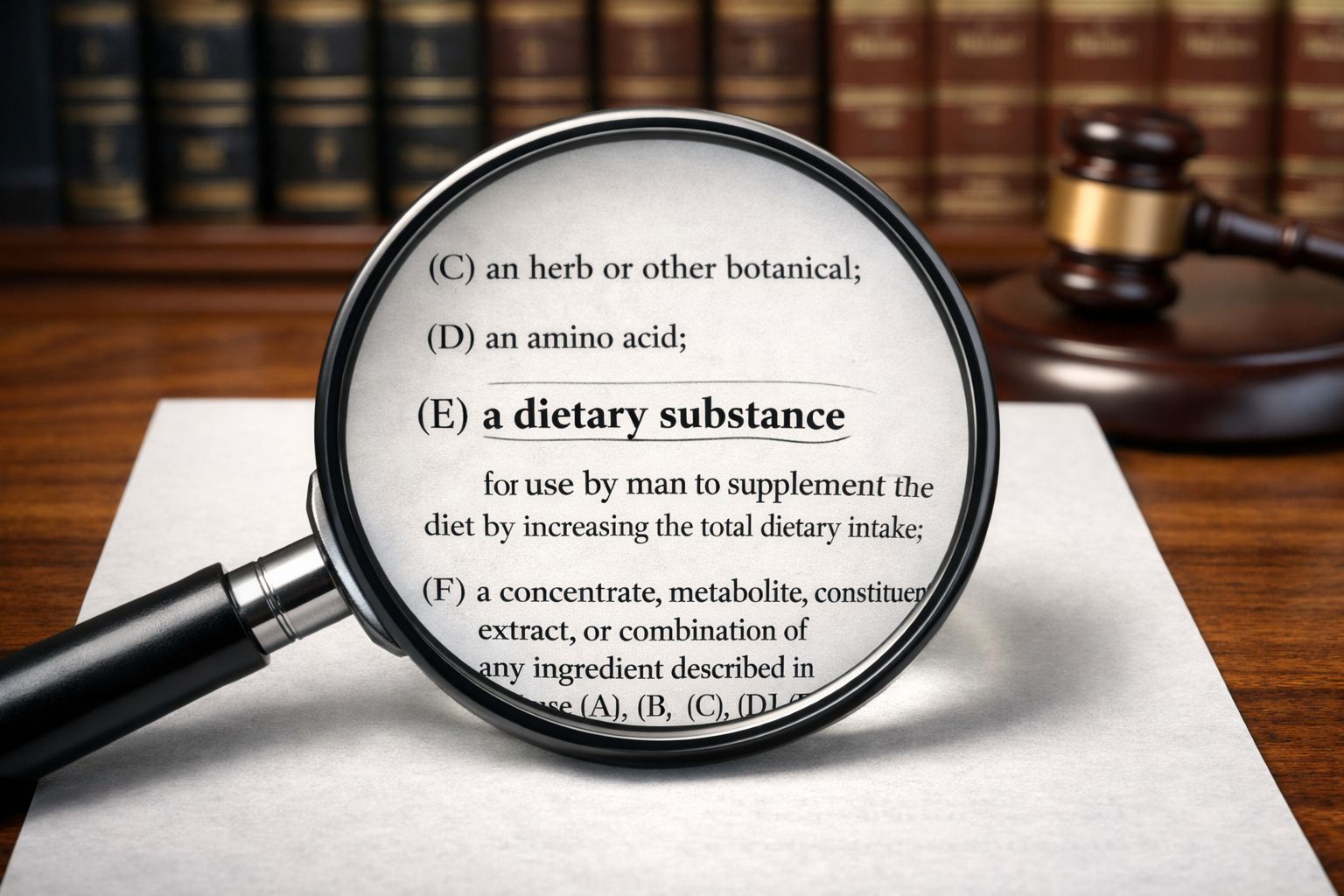
What the heck is a dietary supplement, under the U.S. law known as DSHEA?

A core part of the debate is whether ‘dietary substance’ was intended as the same meaning as ‘present in the food supply’.

Some fringe thinkers want to paint them as the same, and rewrite their own take into law to only include stuff people eat as part of food. But DSHEA was clearly not written or intended that way.

At the March 27, 2026 FDA meeting to examine these questions, attorney Ivan Wasserman brought maybe the clearest interpretation I’ve heard yet.

He mixed in common sense with historical application on DSHEA with Supreme Court precedent, offering an illustration that went beyond — on the meaning of words and why we should heed warning on revisionist thinking.

—-

DSHEA listed several types of substances that are allowed in supplements.

Many herbs, individual amino acids, and metabolites of vitamins are examples of dietary supplement ingredients not necessarily found in the food supply, but which are fully allowed in supplements, by the word of the law.

If an ingredient isn’t in the food supply, the law allows alternative scientific review pathways to determine their safety and legality: Old Dietary Ingredient (ODI) and New Dietary Ingredient (NDI), along with Generally Recognize as Safe (GRAS) are those pathways.

DSHEA FDA Meaning of Dietary Substance

Mr. Wasserman quoted the 1995 case Gustavson vs Alloyd, where Justice Anthony Kennedy wrote, “Under the canon of consistent usage and meaningful variation, a court must presume that a word or phrase bears the same meaning throughout the statute, and conversely that a material variation in terms suggests a variation in meaning.”

Wasserman continued, “We know that the drafters knew the phrase ‘present in the food supply’ and used it in Section 413, but chose not to use it in Section 201 — and instead chose to use the phrase ‘dietary substance.’

“Following Justice Kennedy’s guidance, reading ‘dietary substance’ to have the same meaning as ‘present in the food supply’ is against the canon of statutory interpretation that ‘a material variation in terms suggests a variation in meaning’. It has to have a different meaning.”

—–

Words matter. The intent and the wording of laws matter. And how the law has been practiced for 32 years with a $60 billion industry with an excellent record of safety also matters.

Congress did not invent new terms for dietary substances and dietary ingredients — along with a new process for reviewing their safety in 1994 — for armchair regulators to come along in 2026 and claim they are the same thing as food or drugs.

A clear, new definition of dietary supplement was established by Congress in 1994 — along with the sensible path for how they are to be regulated.

This point, strengthened by Supreme Court precedent that yes, different words have different meanings, may not have been obvious to those in the room falsely claiming to use science to protect public interest.

But it was obvious to the rest of us.

——–

What were my top takeaways from the March 27, 2026 FDA meeting exploring the scope of dietary ingredients, specifically Section 201(ff)(1)(E) of the Federal Food, Drug, and Cosmetic Act: “a dietary substance for use by man to supplement the diet by increasing the total dietary intake”?

1. Supplements continue to be the safest things people can ingest which are regulated by FDA.

If Congress intended for supplements to be food or drugs, they wouldn’t have created and signed DSHEA in 1994. They would have made supplements a food or a drug instead.

DSHEA clearly works as a regulatory framework, even if sufficient budget to enforce it have never been provided.

—-

2. If Congress intended for supplements to be foods, they would not have called the ingredients “dietary substances’ in DSHEA. We wouldn’t be calling them dietary ingredients today. They would have used the other terms already used in 1994 for food ingredients.

If Congress intended for supplement ingredients to be GRASed like food ingredients, DSHEA would not have led to a new classification and safety review process, called New Dietary Ingredient (NDI).

Industry has been waiting on the promised final guidance on NDI notifications for many years. It is not industry’s fault that some firms elect the more strict GRAS path versus NDI. That is also part of the current law since 1958.

—-

3. There’s no evidence the self-affirmed GRAS pathway, called ‘secret GRAS’ by one group, has led to any safety concerns for supplements.

No ingredient is a secret to FDA. They see self-GRAS ingredients at least 2-3 times — at the port, in manufacturing facilities, and on product labels.

If the ‘secret-GRAS’ folks had any evidence of safety concerns of self-affirmed GRAS, surely that would not be kept a secret.

—–

4. It seems to me that the commonsense middle path is right in front of us under DSHEA: FDA can clear the path for NDI by addressing the questions posed by new ingredient technology and answered by the ample science on them.

FDA can also continue to review and request documentation for all self-GRAS ingredients they see at the port, in the facilities and on the label.

Together, this fixes the self-GRAS issue, if there’s one at all.

—–

5. A lack of sufficient Congressional appropriations and funding for dietary supplements at FDA has not been helpful to the process, and along with constantly changing Presidents and their political appointees, has created the current situation of manufactured confusion.

Other developed countries have developed working systems where supplements are regulated somewhere between food and drugs — similar to how Congress intended in 1994.

When Modern Science Collides with Ayurveda

by NaturPro in Uncategorized Comments: 0

What do traditional Ayurveda and modern science have in common — other than repeated testing of hypotheses, and communication of evidence?  

Answer: They both warrant the usage of many herbs for health purposes based on rigorous observation in humans.  

While Ayurveda’s got nothing on our space age, it’s got its own chops as a well-developed, time-tested, evidence-based system. That’s partly why health claims based on traditional usage are recognized by some of the most highly regulated countries (thanks, Aussies and Canadians). But it’s no secret that the U.S. regulatory system completely ignores traditional usage, like in Ayurveda, when it comes to supporting evidence for product benefits. 

Turmeric Extract India

So it’s a good thing that more and more science is published proving Ayurvedic herbs work. And we’re talking the kind of science also used for proving drugs work — even though many herbs don’t work like drugs.  That’s right, many herbs in Ayurveda are increasingly corroborated by the gold standard for the evidence-based camp: their beloved randomized, placebo-controlled clinical trials. Turmeric and boswellia for inflammation. Ashwagandha for stress, stamina and sleep. Bacopa for cognitive support. It’s all there, accessible on PubMed and Google Scholar.

The facts are simple: Ayurveda is an early form of scientific medicine, because it’s actually founded on some central, scientific tenets. The main one being that the body’s composition can be balanced by its environment — including what we consume as food, drink and medicine. 

The evolution of plant medicines from prehistoric to today has always intrigued me. What did many generations of people before us know about health, that we should try to learn and preserve?  And — because the ancients aren’t ALWAYS right – what were their mistakes, or gaps that we need more scientific evidence on?  

There’s no shortage of similarities between the old and the new: Here’s a short list of my favorites between the traditional Ayurvedic and modern scientific application of many of our favorite herbs:

  1. Evidence-Based Practices. Ayurveda relies on empirical observations and historical practices of risk versus benefit. Modern science is similar, taking scientific evidence-based approaches and comparing them to currently accepted practices. Both systems recognize the importance of evaluating the effectiveness of treatments, and exploring new ideas. 
  • Holistic Approach to Health: Both Ayurveda and modern science acknowledge that health is a state of overall well-being, and not just the absence of disease. Prevention is worth a pound of cure, wherever you are in this world.
  • Use of Natural Products: Both traditional and modern scientific systems recognize the potential benefits of natural substances, including botanicals and other nutrients for promoting health and treating various health conditions. 
  • Digestive Health: Ayurveda places significant emphasis on digestive health, considering it the foundation of overall well-being. Modern research has explored the gastrointestinal benefits of traditionally fermented foods, spices and plant foods in Ayurveda. The validation of carminative and aromatic herbs like ginger and cinnamon by science are a couple examples. 
  • Adaptogens & Antioxidants: Ayurveda introduced the concept of adaptogens, botanicals that help the body adapt to stress and maintain balance. Modern research has investigated herbs like ashwagandha and holy basil as adaptogens. Also both Ayurveda and modern science acknowledge the importance of antioxidants in combating oxidative stress and preventing cellular damage. The ‘rasayana’ or rejuvenation tonics in Ayurveda are formulated with adaptogen- and antioxidant-rich herbs, and when investigated in clinical trials, have resulted in some promising findings. 
  • Mind-Body Connections: Ayurveda recognizes the interconnectedness of the mind and body. Similarly, modern science acknowledges the role of psychological and mental factors in physical and general health. For example, herbs like bacopa have been used in Ayurveda to support cognitive function, and modern research has studied its potential cognitive-enhancing effects.

For the full article, download the Natural Products Insider Digital Magazine.

The Bad Supplements List: Failed and Prohibited Products and Brands

by NaturPro in Uncategorized Comments: 0

The Bad Supplements List: Failed and Prohibited Products and Brands. The Bad Supplements List documents and reviews clear and reliable evidence, using publicly available information on testing and enforcement activities on U.S. dietary supplement brands and products.